Read With Your Best Friends Before You Get Killed by a Bees
It'southward Your Friends Who Suspension Your Eye
The older we get, the more nosotros demand our friends—and the harder it is to keep them.
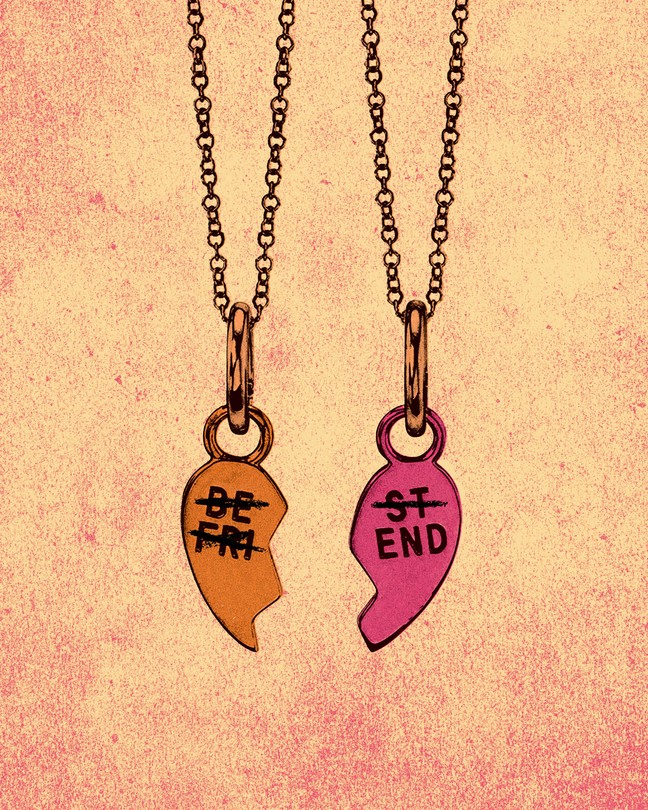
It is an insolent cliche, almost, to note that our culture lacks the proper script for ending friendships. Nosotros have no rituals to observe, no paperwork to do, no average dialogue to crib from.
Even so when Elisa Albert and Rebecca Wolff were in the last throes of their friendship, they managed, entirely past accident, to leave backside merely such a script. The problem was that it read like an Edward Albee play—tart, unsparing, fluorescent with rage.
I met Elisa 1 evening in 2008, after an old friend's volume reading. She was such mesmerizing company that I rushed out to buy her debut novel, The Book of Dahlia, which had been published a few months earlier. I was instantly struck by how unafraid of darkness and emotional anarchy she was. The aforementioned articulate fury suffused After Birth, her follow-upwardly; her next volume, Human Dejection (her "monster," every bit she likes to say), comes out in July.
Rebecca is someone I knew only by reputation until recently. She'southward the founding editor of the literary mag Contend, a haven for genre-resistant writing and writers that's now nigh 25 years onetime. She's also the author of a novel and 4 verse collections, including Manderley, selected past the National Poetry Serial; she has a fifth coming out in the fall.
The ii women became close more than a decade ago, spotting in each other the same traits that dazzled outsiders: talent, charisma, saber-tooth smarts. To Rebecca, Elisa was "impossibly vibrant" in a way that only a 30-twelvemonth-one-time can exist to someone who is 41. To Elisa, Rebecca was a glamorous and reassuring role model, a woman who through some miracle of alchemy had successfully combined motherhood, spousal relationship, and a artistic life.
It would be hard to enlarge how much that mattered to Elisa. She was a new female parent, all alone in a new urban center, Albany, where her husband was a tenured professor. (Albany! How does one find friends in Albany?) Even so here was Rebecca—the center of a lush social network, a pollinating bee—showing up on campus at Fence'south function every day.
The 2 entered an intense loop of contact. They took a class in New York City together. They sometimes joked about running abroad together. And, eventually, they decided to write a book together, a drove of their email and text correspondence well-nigh a topic with undeniably broad appeal: how to live in the world and be okay. They chosen this project The Wellness Letters.
I read the manuscript in i gulp. Their exchanges have real swing to them, a screwball quality with a punk twist. On page 1:
R: Anything you haven't done?
E: Affair. Acid. Shrooms. 2d child. Death. Ayahuasca.
R: "Bucket List."
Eastward: "Efforts at Health."
R: I merely started writing something called Trying to Stay Off My Meds …
E: U R A STRONG Adult female.
But over time, resentments flicker into view. Deep fissures in their belief systems brainstorm to show. They start writing past each other, non hearing each other at all. By the stop, the two women accept taken every difficult truth they've ever learned about the other and fashioned information technology into a club. The final paragraphs are a mess of blood and bone and gray guts.
In existent fourth dimension, Elisa and Rebecca enact on the page something that almost all of u.s.a. have gone through: the painful dissolution of a friendship.
The specifics of their disagreements may be unique to them, merely the broad outlines take the band and shape of the familiar; The Wellness Letters are nigh impossible to read without seeing the corpse of ane of your own doomed friendships floating by.
Elisa complains about failures in reciprocity.
Rebecca implies that Elisa is being insensitive, too quick to estimate others.
Elisa implies that Rebecca is beingness as well self-involved, too needy.
Rebecca implies: Now you're likewise quick to judge me.
Elisa ultimately suggests that Rebecca'south unhappiness is at to the lowest degree partly of her own unlovely making.
To which Rebecca more than or less replies: Who on earth would choose to be this unhappy?
To which Elisa basically says: Well, should that exist an excuse for existence a myopic and inconsiderate friend?
E: The truth is that I am wary of you lot …
R: When y'all say that you lot are wary of me, it reminds me of something … oh yeah, information technology's when I told you that I was wary of you … wary of your clear pattern of forming mutually idolatrous relationships with women who you cast in a particular part in your life merely to later castigate.
Their feelings were too hot to comprise. What started as a deliberate, thoughtful meditation about health ended equally an inadvertent chronicle of a friendship gone terribly amiss.
The Wellness Messages, 18 months of electrifying correspondence, now sit mute on their laptops.
I first read The Wellness Letters in December 2019, with a different projection in mind for them. The pandemic forced me to set it aside. But 2 years later, my mind kept returning to those letters, for reasons that at this point accept also become a cliché: I was undergoing a Great Pandemic Friendship Reckoning, along with pretty much everyone else. All of those hours in isolation had amounted to one long spin of the centrifuge, separating the thickest friendships from the thinnest; the ambient threat of death and loss made me realize that if I wanted to renew or intensify my bonds with the people I loved most, the time was now, correct now.
Desire to explore more of the ideas and science behind well-being? Join Atlantic writers and other experts May 1–3 at The Atlantic'south In Pursuit of Happiness issue. Learn more virtually in-person and virtual registration hither.
But truth exist told, I'd already been mulling this subject area for quite some fourth dimension. When yous're in center age, which I am (mid-center age, to be precise—I'thousand now 52), yous commencement to realize how very much y'all need your friends. They're the flora and fauna in a life that hasn't had much variety, because you've been then busy—and so relentlessly, stupidly busy—with middle-age things: kids, house, spouse, or some modern-day version of Zorba's full ending. So one day y'all look up and discover that the ambition monkey has fallen off your back; the children into whom y'all've pumped thousands of kilowatt-hours are no longer partial to your company; your partner may or may non withal be by your side. And what, so, remains?
With any luck, your friends. Co-ordinate to Laura Carstensen, the director of the Stanford Center on Longevity, I've aged out of the friendship-collecting business, which tends to pinnacle in the tumbleweed stage of life, when you're still young enough to spend Saturday evenings with random strangers and Sun mornings nursing hangovers at brunch. Instead, I should exist in the friendship-enjoying business organisation, luxuriating in the relationships that survived as I put downward roots.
And I am luxuriating in them. Simply those friendships are clumsily difficult-won. With midlife comes a number of meaning upheavals and changes, ones that bear witness besides much for many friendships to withstand. By eye age, some of the dearest people in your life have gently faded away.
You lot lose friends to wedlock, to parenthood, to politics—fifty-fifty when y'all share the aforementioned politics. (Political obsessions are a large, underdiscussed friendship-ender in my view, and they seem to only deepen with age.) You lose friends to success, to failure, to flukish strokes of skillful or ill luck. (Envy, love God—it'southward the mother of all unspeakables in a friendship, the lulu of all shames.) These life changes and upheavals don't just swallow your friends' time and attending. They oftentimes reveal unseemly characterological truths about the people you love most, behaviors and traits you previously hadn't imagined possible.
Those are fell.
And I've still left out three of the most common and dramatic friendship disrupters: moving, divorce, and death. Though only the last is irremediable.
The unhappy truth of the matter is that it is normal for friendships to fade, fifty-fifty nether the best of circumstances. The real aberration is keeping them. In 2009, the Dutch sociologist Gerald Mollenhorst published an attending-grabber of a study that basically showed we supplant half of our social network over the course of seven years, a reality nosotros both practice and don't intuit.
R: I'm worried in one case we wrap upward our dialogue our friendship will be useless, therefore done.
E: Nope. We r deeply in dialogue for long run I think. Unless U desire to non b. Does our friendship feel useless?? …
R: No I want to be friends forever
E: And so we will b
Were friendships always so fragile? I doubtable not. But we now live in an era of radical individual freedoms. All of us may begin at the aforementioned starting line as young adults, but as soon equally the gun goes off, nosotros're all running in different directions; in that location's trivial synchrony to our lives. We accept kids at dissimilar rates (or not at all); nosotros pair off at dissimilar rates (or not at all); we move for honey, for piece of work, for opportunity and adventure and more affordable real estate and healthier lifestyles and improve weather.
However it'southward precisely because of the atomized, customized nature of our lives that we rely on our friends so very much. We are recruiting them into the roles of people who once only coexisted with us—parents, aunts and uncles, cousins, young man parishioners, beau union members, fellow Rotarians.
Information technology's non wholly natural, this concern of making our ain tribes. And it inappreciably seems conducive to human thriving. The percentage of Americans who say they don't take a single close friend has quadrupled since 1990, co-ordinate to the Survey Center on American Life.
1 could argue that modern life conspires against friendship, even as information technology requires the bonds of friendship all the more.
When I was younger, my friends had as much a hand in authoring my personality as any other force in my life. They brash me on what to read, how to dress, where to eat. But these days, many are showing me how to recall, how to alive.
It gets trickier equally yous age, living. More than bad things happen. Your parents, if you lot're lucky plenty to still have them, have lives and then different from your ain that y'all're looking horizontally, to your ain accomplice, for cues. And you're dreading the days when an older generation will no longer exist there for you—when you'll have to rely on another ecosystem altogether for support.
Yet for the past decade or then, I've had a tacit, common agreement with many of the people I dearest most, particularly fellow working parents: Look, life's crazy, the role has loaded me up similar a pack fauna, we'll catch up when we grab upwardly, beloved you in the meantime. This happens to adapt a rotten tendency of mine, which is to work rather than play. I could give you all sorts of therapized reasons for why I do this, merely honestly, at my age, information technology's embarrassing. There comes a point when you take to wake up in the morning and determine that it doesn't affair how you got to whatever sad cul-de-sac you're circumvoluted; yous simply have to find a mode out.
I recollect of Nora Ephron, whose death defenseless nigh all of her friends past surprise. Had they known, they all said afterward—had they just known that she was ill—they'd have savored the dinners they were having, and they certainly wouldn't have taken for granted that more of them would stretch forever into the hereafter. Her sudden disappearance from the world revealed the fragility of our bonds, and how presumptuous we all are, how careless, how naive.
But shouldn't this fragility always be tiptop of listen? Surely the pandemic has taught us that?
I mean, how long can we all keep postponing dinner?
When I began writing this story, my friend Nina warned me: Do not make this an occasion to rake through your own history and shell yourself upwards over the state of your ain friendships. Which is something that merely a dear friend, armed with protective instincts and a Spidey sense nigh her friend'southward self-lacerating tendencies, would say.
Fair enough. Merely information technology's hard to write a story about friendship in midlife without thinking nigh the friends yous've lost. "When friendship exists in the groundwork, information technology's unremarkable but by and large elementary," wrote B. D. McClay, an essayist and critic, in Lapham'south Quarterly concluding spring. "Just when friendship becomes the plot, then the only story to tell is about how the friendship ended."
Friendship is the plot of this article. So naturally I'1000 going to write at to the lowest degree a little about those I've lost—and my regrets, the choices I've made, the fourth dimension I have and have non invested.
On the positive side of the ledger: I am a loyal friend. I am an empathetic friend. I seldom, if ever, guess. Tell me you murdered your mother and I'll say, Gee, you must take been really mad at her. I am quick to remind my friends of their virtues, telling them that they are beautiful, they are brilliant, they are superstars. I spend coin on them. I often limited my love.
On the negative side: I'thousand oversensitive to slights and pocket-sized humiliations, which means I'thou wrongly inclined to see them as intentional rather than pedestrian acts of thoughtlessness, and I get easily overwhelmed, engulfed. I can about never mentally justify answering a spontaneous phone call from a friend, and I have to force myself to phone and e-mail them when I'one thousand hard at work on a projection. I'grand that prone to monomania, and that consumed by my own tension.
What both of these traits accept in common is that I seem to live my life as if I'm under siege. I'chiliad guessing my amygdala is the size of a cantaloupe.
Virtually of my withered friendships can exist chalked up to this terrible tendency of mine not to attain out. I have pals in Washington, D.C., where I started my professional life, whom I haven't seen in years, and friends from college I haven't seen since practically graduation—people I one time adored, shared my life with, couldn't take imagined living for two seconds without.
And however I do. I have.
This is, mind yous, how nigh friendships die, co-ordinate to the social psychologist Beverley Fehr: non in pyrotechnics, but a serenity, gray deliquesce. It's non that anything happens to either of you; it's just that things cease happening between you. And so you drift.
It'southward the friendships with more deliberate endings that torment. At best, those dead friendships only hurt; at worst, they feel like personal failures, each one amounting to a footling divorce. It doesn't matter that most were undone by the subconscious trip wires of midlife I talked about before: marriage, parenthood, life'due south random slings and arrows. By midlife, you've invested enough in your relationships that every loss stings.
Y'all feel bereft, for one affair. Every bit if someone has wandered off with a slice of your history.
And you fearfulness for your reputation. Friends are the custodians of your secrets, the eyewitnesses to your weaknesses. Every confession you've made—all those naked moments—can be weaponized.
There was the friend I lost to parenthood, utterly, though I was also a parent. Her kid shortly consumed her world, and she had many child-rearing opinions. These changes alone I could have handled; what I couldn't handle was her obvious disapproval of my ain parenting style (hands-off) and my lack of sentimentality virtually maternity itself (if you lot don't accept something prissy to say about raising kids, pull up a chair and sit down side by side to me).
There was no operatic breakup. She moved abroad; I made zero effort to stay in affect. But whenever I recall of her, my stomach chirps with a kind of longing. She showed me how cognitive behavioral therapy worked before I fifty-fifty knew it was a thing, rightsizing my perspective each time I turned a wispy cirrus into a thunderhead. And her chat was tops, weird and unpredictable.
I miss her. Or who she was. Who we were.
I lost a male friend in one case to parenthood too, though that situation was different. In this instance, I was not however a female parent. But he was a dad, and on account of this, he testily informed me 1 twenty-four hours, he now had higher moral obligations in this world than to our friendship or to my feelings, which he'd just seriously hurt (over something that in hindsight I'll confess was pretty fiddling). While I knew on some level that what he said was true, I couldn't quite believe he was proverb it out loud, this person with whom I'd spent and so many idle, gleeful hours. I miss him a lot, and wonder to this solar day whether I should have just permit the annotate go.
All the same whenever I retrieve of him, a fiery asterisk however appears next to his proper noun.
Mahzad Hojjat, a social-psychology professor at the Academy of Massachusetts at Dartmouth, one time told me that people may say that friendship betrayals aren't as bad as romantic betrayals if they're presented with hypothetical scenarios on a questionnaire. Merely that'southward not how they experience friendship betrayals in real life. This doesn't surprise me. I even so have sense-memories of how sickened I was when this friend told me I'd been relegated to a lower league—my eye quickening, the blood thumping in my ears.
Then there was the friend who didn't say annihilation hurtful to me per se; the trouble was how fiddling she said about herself at all. Co-ordinate to Hojjat, failures of reciprocity are a huge theme in cleaved friendships. That stands to reason—asymmetries of time and attempt tin can continue for only so long before you feel like you lot've lost your nobility. (I myself take been criticized for neglect and laziness, and rightly. It'due south shitty.) Merely in that location's a subtler kind of disproportion that I think is far more devastating, and that is a certain lopsidedness in self-disclosure. This friend and I would have long lunches, dinners, coffees, and I'd be frank, ever, virtually my disappointments and travails. I consider this a grade of currency between women: You trade confidences, small glass fragments of yourself.
But non with her. Her life was always fine, bang-up, just couldn't exist better, thanks. Talking with her was like playing strip poker with someone in a downward parka.
I mentioned this problem to Hojjat. She ventured that perhaps women await more of their female friends than men exercise of their male companions, given how intimate our friendships tend to exist. In my small-scale, unscientific personal sample of friends, that's certainly true.
Which brings me to the subject of our Problem Friends. Most of us take them, though we may wish we could tweeze them from our lives. (I've had 1 for decades, and though on some level I'll always dear her, I resolved to be done with her during this pandemic—I'd grown weary of her volatility, her storms of anger.) Unfortunately, what the inquiry says near these friends is depressing: It turns out that time in their company can be worse than time spent with people we actively dislike. That, at whatsoever rate, is what the psychologist Julianne Holt-Lunstad discovered in 2003, when she had the inspired thought to monitor her subjects' claret pressure level while in the presence of friends who generated conflicted feelings. It went upward—even more than it did when her subjects were in the presence of people with whom they had "aversive" relationships. Didn't affair if the conversation was pleasant or not.
You lot have to wonder whether our bodies accept always known this on some level—and whether the pandemic, which for a long while turned every social interaction into a possible health risk, fabricated all of our trouble friends easier to give the slip. It'due south non just that they're potentially bad for y'all. They are bad for yous. And—alas—always were.
A brief word here most the scholarship devoted to friendship: I know I've been citing it quite a flake, but the truth is, there'southward surprisingly petty of it, and fifty-fifty less that's particularly good. A neat deal is dime-store wisdom crowned in the laurels of peer review, dispatches from the Empire of the Obvious. (When I get-go wrote to Elisa about this topic, she replied with an implicit eye scroll. "Lemme guess: Long term intimate relationships are good for u!")
Yous have perhaps heard, for instance, of Holt-Lunstad's 2010 meta-analysis showing that a robust social network is every bit beneficial to an private'due south health as giving up cigarettes. So yep: Relationships really are good for u.
But friendship, mostly speaking, is the redheaded stepchild of the social sciences. Romantic relationships, marriage, family unit—that's where the real grant money is. They're a wormy mess of ties that bind, whether by blood, sexual activity, or law, which makes them hotter topics in every sense—more than seductive, more fraught.
Merely this lacuna in the literature is also a little odd, given that most Americans accept more friends than they practice spouses. And one wonders if, in the near time to come, this gap in quality scholarship may beginning to fill up.
In a book published in the summer of 2020, Big Friendship, Aminatou Sow and Ann Friedman, the hosts of the podcast Call Your Girlfriend, argued that some friendships are and then important that we should consider assigning them the aforementioned priority nosotros do our romantic partnerships. They certainly view their own friendship this way; when the two of them went through a rough patch, they went so far as to see a therapist together.
I mentioned this to Laura Carstensen. Her first reaction was ane of utter bewilderment: "But … it's the whole thought that friendships are voluntary that makes them positive."
Practically everyone who studies friendship says this in some form or another: What makes friendship then delicate is also exactly what makes information technology and so special. You lot have to continually opt in. That you choose it is what gives it its value.
But equally American life reconfigures itself, nosotros may notice ourselves rethinking whether our spouses and children are the only ones who deserve our binding commitments. When Sow and Friedman went into counseling together in their 30s, Sow was unmarried, which hardly made her unusual. According to a 2020 survey past the Pew Enquiry Center, near a quarter of American adults ages xxx to 49 are unmarried—and single here doesn't only mean unmarried; it means not dating anyone seriously. Neither woman had (or has) children, either, a fact that could of form change, merely if information technology doesn't, Sow and Friedman would scarcely be solitary. Virtually 20 percent of American adults ages 55 to 64 take no children, and 44 percent of current nonparents ages 18 to 49 say they remember it's unlikely they e'er will.
"I have been with family unit sociologists who think it's crazy to retrieve that friends could replace family unit when you realize yous're in real trouble," Carstensen told me. "Yeah, they say, they'll bring you soup when you have the flu, merely they're unlikely to treat you when y'all have dementia. But we could attain a point where close friends do quit their jobs to care for you when you have dementia."
Friendship is the rare kind of relationship that remains forever available to us as we age. It's a bulwark against stasis, a potential source of creativity and renewal in lives that otherwise narrow with time.
"I've recently built a whole community of people half my historic period," says Esther Perel, 63, the psychotherapist and host of the immensely popular podcast Where Should Nosotros Begin?, in which she conducts a 1-off couples-therapy session with anonymous clients each episode. "It'southward the most important shift in my life, friendship-wise. They're at my dinner table. I have 3 friends having babies." These intergenerational friendships, she told me, are one of the unexpected joys of middle age, giving her access to a new vocabulary, a new civilisation, a new prepare of mores—at simply the moment when the culture seems to have passed her generation by.
When nosotros spoke, Perel was likewise preparing for her very first couples-therapy session with two friends, suggesting that Sow and Friedman were onto something. "The pandemic has taught us the importance of mass common reliance," Perel said. "Interdependence has to conquer the lonely, individualistic nature of Americans." Every bit a native of Belgium, Perel has always plant this aspect of American life a little baffling, particularly when she was a new mother. "In my culture, yous enquire a friend to babysit," she told me. "Hither, first you endeavour to rent someone; then you become and 'impose.' And I thought: This is warped. This has got to shift."
Might it now? Finally?
Elisa and Rebecca nurtured each other as if they were family unit—and often in ways their own families did not. When they met, Elisa was a new mother, and her parents were 3,000 miles abroad. Rebecca became her proxy parent, coaching her through breastfeeding and keeping her company; she fifty-fifty smelled like Elisa's mom. "I can't draw the scent, but it's You lot, and information technology'due south HER; it'due south no cosmetic," Elisa subsequently wrote in The Wellness Letters, calculation,
and your birthdays are adjacent and you are very much like her in some deep, meaningful ways, it seems to me. There is no one I can talk to the way I can talk to her, and to you. Her intelligence is vast and curious and artless and insatiable and transcendent, like yours.
When they met, Rebecca was nevertheless married. While Rebecca's marriage was falling apart, it was Elisa who threw open up her doors and gave Rebecca the run of her downstairs floor, providing a refuge where she could think, agonize, crash. "We were sort of in that thing where yous're similar, 'You're my savior,' " Rebecca told me. "Similar, yous cling to each other, considering y'all've found each other."
So what, ultimately, undid these two spit sisters?
On 1 level, information technology appeared to exist a significant difference in philosophy. Namely: how they each thought nigh depression.
Rebecca struggles with major depression. Elisa has had experiences with the black domestic dog as well, going through long spells of trying to bring it to heel. But she hates this discussion, depression, thinks it decanted of all significant, and in her view, we accept a choice near how to respond to it.
R: When I'm really depressed I feel, and therefore am, at a painful remove from "life" … Even as I was aware that I was doing it all the time, this thing called "being a man" … it was not what I imagined living to feel like. And I have spent years substantially faking it, only reassuring myself that at to the lowest degree from the exterior I look like I'm live …
Eastward: Jesus Christ, dude, first thought: you must arctic. You must CHILL. This is non particularly empathetic, I'm sorry. I just want to get you down on the floor for a while. I want to get you animate. I want to get you out of your caput and into your hips, into your anxiety. I want to loosen you up. That is all.
To Elisa, women have been sold a false story about the origins of their misery. Anybody talks about encephalon chemistry. What about trauma? Screwy families? The birth-command pills she took from the time she was 15, the junk food she gorged on as a child?
E: THE BODY, dude. All I intendance near is THE Torso. The mind is a fucking joke … Remind me to tell you about the time they prescribed me Zoloft in college after my brother died. Pills for grief! I am endlessly tickled by this now.
But pills for grief—that is, in fact, exactly what Rebecca would debate she needed.
Around and effectually the two went. The way Elisa saw information technology, Rebecca was using her low as an excuse for bad choices, bad behavior. What Rebecca read in Elisa'due south emails was a reproach, a failure to grasp her pain. "If there's no such thing every bit depression," she wrote in The Health Letters, "what is this duck sitting on my head?"
Information technology'southward a painfully familiar dynamic in a friendship: One friend says, Get a grip already. And the other one says, I'm trying. Can't you see I'g trying? Neither party relishes her role.
Eventually, Rebecca started taking medication. And once she did, she pulled away, vanishing for weeks. Elisa had no idea where she'd gone.
East: Well, our dialogue has turned into a monologue, only I am undaunted. Are you unmoved to write to me because your meds have worked so well that you're now perfectly functional, to the extent that yous need not go searching for means to narrate/make sense of your internal landscape?
Weirdly, this explanation was not far off. When Rebecca eventually did respond, the commutation did not end well. Elisa accused her of never apologizing, including for this moment. She accused Rebecca of political blowhard in their most recent correspondence, rather than talking virtually health. Just Elisa besides confessed that perhaps Rebecca happened to be communicable her on a bad day—Elisa'southward mother had just phoned, and that phone call had driven her into a rage.
This last point gave Rebecca an opening to share something she'd clearly been wanting to say for a long fourth dimension: Elisa was forever comparing her to her female parent. But Elisa was also forever complaining about her mother, saying that she hated her mother. Her mother was, variously, "sadistic," "untrustworthy," and "a monster." So finally Rebecca said:
In all the means yous've spoken near your mother, I don't call up you e'er describing to me the bodily things she'south washed, what makes you experience so destroyed by her.
To which Elisa replied that this was exactly the manipulative, hurtful type of gaslighting in which her mother would indulge.
Information technology was at this moment that I, the reader, finally realized: This wasn't simply a fight over differences in philosophy.
If our friends become our substitute families, they pay for the failures of our families of origin. Elisa'due south was such a mess—a blood brother long expressionless, parents long divorced—that her unconscious efforts to re-create it were e'er going to be fraught. And on some level, both women knew this. Elisa said information technology outright. When she first wrote in The Wellness Letters that Rebecca smelled like her mother, Elisa mused:
What's my point? Something about mothers and children, and the unmothered, and human frailty, and imprinting. Something about friendship, which can and should provide support and understanding and company and a different sort of imprinting.
A different sort of imprinting. That'southward what many of us, consciously or not, wait for in friendships, isn't it? And in our marriages too, at least if you believe Freud? Improved versions of those who raised us?
"I have no answers about how to ensure only good relationships," Elisa concluded in one email to Rebecca. "But I estimate exercise? Trial and error? Revision?"
That actually is the question. How do you ensure them?
Dorsum in the 1980s, the Oxford psychologists Michael Argyle and Monika Henderson wrote a seminal paper titled "The Rules of Friendship." Its six takeaways are obvious, only what the hell, they're worth restating: In the well-nigh stable friendships, people tend to stand up for each other in each other'southward absence; trust and confide in each other; support each other emotionally; offer assistance if information technology'south required; attempt to make each other happy; and go along each other upward-to-date on positive life developments.
It's that concluding one where I'm e'er falling down. Keeping upwardly contact, ideally embodied contact, though fifty-fifty semi-embodied contact—past voice, over the phone—would probably suffice. Just when reading Elisa and Rebecca in atom-splitting meltdown did I realize just how crucial this habit is. The 2 women had get theoretical to each other, the sum simply of their ideas; their friendship had migrated virtually exclusively to the folio. "The writing took the place of our existent-life relationship," Elisa told me. "I felt like the writing was the friendship."
In this way, Elisa and Rebecca were creating the conditions of a pandemic before there even was one. Had anyone read The Health Letters in 2019, they could take served as a cautionary tale: Our COVID year of lost embodied contact was not adept for friendship. According to a September survey by Pew, 38 percent of Americans now say they feel less close to friends they know well.
The problem is that when it comes to friendship, we are ritual-deficient, nearly devoid of rites that force us together. Emily Langan, a Wheaton College professor of communication, argues that we need them. Friendship anniversaries. Regular route trips. Sunday-night phone calls, annual gatherings at the same rental business firm, any it takes. "We're non in the addiction of elevating the practices of friendship," she says. "But they should exist similar to what we exercise for other relationships."
When I consider the people I know with the greatest talent for friendship, I realize that they do simply this. They make contact a priority. They leap in their cars. They appear at regular intervals in my inbox. Ane told me she clicks open her address book every now and and then but to check which friends she hasn't seen in a while—and so immediately makes a date to get together.
Laura Carstensen told me during our chat that good friends are for many people a key source of "unconditional positive regard," a phrase I proceed turning over and over in my mind. (Non hers, I should notation—the term was popularized in the 1950s, to depict the ideal therapist-patient relationship. Carstensen had the good sense to repurpose information technology.) Her observation perfectly echoed something that Benjamin Taylor, the author of the lovely memoir Hither We Are, said to me when I asked about his shut friendship with Philip Roth. What, I wanted to know, fabricated their relationship work? He thought for so long that I assumed the line had gone expressionless.
"Philip made me feel that my best self was my real cocky," he finally said. "I think that'due south what happens when friendships succeed. The person is giving back to yous the feelings you wish you could give to yourself. And seeing the person yous wish to be in the world."
I'yard non the sampler-making sort. Just if I were, I'd sew these words onto one.
Perhaps the best book well-nigh friendship I've read is The Undoing Projection, by Michael Lewis. That might be a foreign thing to say, because the volume is not, on its face, almost friendship at all, simply about the nascency of behavioral economics. Even so at its center is the story of an exceptionally complicated human relationship between two giants of the field. Amos Tversky was a buffalo of charisma and conviction; Daniel Kahneman was a sparrow of anxiety and neuroticism. The early years of their collaboration, spent at Hebrew University in the belatedly 1960s, were empty-headed and all-consuming, almost like beloved. Just equally their fame grew, a rivalry developed between them, with Tversky ultimately emerging equally the better-known of the ii men. He was the one who got invited to fancy conferences—without Kahneman. He was the ane who got the MacArthur genius grant—not Kahneman. When Kahneman told Tversky that Harvard had asked him to join its faculty, Tversky blurted out, "It's me they desire." (He was at Stanford at the time; Kahneman, the Academy of British Columbia.)
"I am very much in his shadow in a way that is not representative of our interaction," Kahneman told the psychiatrist Miles Shore, who interviewed him and Tversky for a project on creative pairs. "Information technology induces a certain strain. In that location is envy! Information technology's only disturbing. I hate the feeling of envy."
Whenever I mentioned to people that I was working on a story about friendship in midlife, questions nigh envy invariably followed. It's an irresistible discipline, this thing that Socrates called "the ulcer of the soul." Paul Blossom, a psychology professor at the University of Toronto, told me that many years ago, he taught a seminar at Yale about the seven deadly sins. "Green-eyed," he said dryly, "was the one sin students never boasted about."
He'south right. With the exception of envy, all of the deadly sins tin be pleasurable in some way. Rage can be righteous; animalism can be thrilling; greed gets you all the good toys. But cypher feels good almost envy, nor is there any clear way to slake it. You tin work out acrimony with boxing gloves, sate your gluttony by feasting on a cake, boast your style through cocktail hour, or slumber your way through tiffin. But envy—what are you to do with that?
Dice of it, as the expression goes. No ane ever says they're dying of pride or sloth.
Nevertheless social scientific discipline has surprisingly little to say about envy in friendship. For that, you lot need to consult artists, writers, musicians. Gore Vidal complained, "Every time a friend succeeds, something inside me dies"; Morrissey sang "We Hate Information technology When Our Friends Become Successful." Envy is a ubiquitous theme in literature, spidering its way into characters as broad-ranging equally Lenù and Lila, in Elena Ferrante's Neapolitan novels, and pretty much every malevolent neurotic ever conjured by Martin Amis (the embodiment existence Richard Tull, the failed novelist and minor critic of The Information, who smacks his son when his rival lands on the best-seller list).
In the leap 2021 issue of The Yale Review, Jean Garnett, an editor at Niggling, Brownish, wrote a terrific essay almost envy and identical twinship that feels just every bit applicable to friendship. My favorite line, bar none: "I tin can be a very generous sister—maternal, fifty-fifty—as long equally I am winning."
With those fifteen words, she exposes an uncomfortable truth. Many of our relationships are predicated on subtle differences in ability. Rebalance the scales, and it's anyone's guess if our fragile egos survive. Underneath envy, Garnett notes, is the cloak-and-dagger wish to shift those weights back in our favor, which actually ways the shameful wish to destroy what others have. Or as Vidal too (more or less) said: "It is non plenty to succeed; a friend must also neglect."
At this point, pretty much anybody I know has been kicked in the head in some mode. We've all got our satchel of disappointments to lug effectually.
But I did feel green-eyed adequately acutely when I was younger—especially when it came to my girlfriends' appearances and self-confidence. One friend in particular filled me with dread every time I introduced her to a boyfriend. She's a knockout, turns heads everywhere; she both totally knows this and doesn't accept a clue. I have vivid memories of wandering a museum with her i afternoon and watching men silently trail her, finding all dopey manner of excuses to chat her up.
My trend in such situations is to plow my part into shtick—I'1000 the wisecracking Daria, the mordant brunette, the one whose qualities will age well.
I hated pretending I was higher up it all.
What made this situation survivable was that this friend was—and yet is—forever telling me how groovy I look, even though it's perfectly apparent in any given situation that she'south Prada and I'chiliad the knockoff on the street vendor's blanket. Any. She means information technology when she tells me I look great. I dear her for saying it, and proverb it repeatedly.
In recent years, I have had one friend I could have badly envied. He was my office spouse for almost two decades—the other half of a two-headed vaudeville act now a quarter century quondam. We bounced every story idea off each other, edited each other, took our book leaves at the same fourth dimension. So I got a new job and he went off to work on his second volume, which he phoned to tell me i twenty-four hours had been selected by … Oprah.
"You're kidding!" I said. "That's fucking amazing."
Which, of form, information technology was. This wasn't a lie.
But in the cramped quarters of my ego, crudely bound together with bubble glue and Popsicle sticks, was information technology all that fucking amazing?
No. Information technology wasn't. I wanted, briefly, to dice.
Here'due south the matter: I don't permit myself as well many silly, Walter Mitty–like fantasies of glory. I'm a pessimist by nature, and anyhow, fame has never been my endgame in life.
Just I did kinda sorta secretly hope to one 24-hour interval be interviewed from Oprah Winfrey's yoga nook.
That our friendship hummed along in spite of this bolt of fortune and success in his life had absolutely nothing to exercise with me and everything to do with him, for the uncomplicated reason that he connected to be his vulnerable self. (It turns out that lucky, successful people still have problems, but unlike ones.) It helped that he never lost sight of my ain strengths, either, even if I felt inadequate for a while by comparison. One day, while he was busy burdensome it, I glumly confessed that I was miserable in my new job. And so go exist awesome somewhere else, he said, equally if awesomeness were some essential property of mine, how y'all'd ascertain me if I were a metallic or a rock. I call up I started to cry.
It helped, too, that my friend genuinely deserved to be on Oprah. (His name is Bob Kolker, by the way; his book is Hidden Valley Road, and everyone should read it, because information technology is truly a marvel.)
It's the well-nigh-ness of envy that kills, as Garnett points out in her essay—the fact that it could have or should have been usa. She quotes Aristotle'south Rhetoric: "We envy those who are nearly us in time, place, age, or reputation … those whose possession of or success in a thing is a reproach to the states: these are our neighbors and equals; for it is clear that it is our ain fault we accept missed the good thing in question."
And I have no clue what I would have done if Bob hadn't handled his success with humility and tact. If he'd become monstrously exhibitionistic—or, okay, fifty-fifty just a little fleck conceited—I honestly think I wouldn't have been able to cope. Adam Smith noted how essential this restraint is in The Theory of Moral Sentiments. If a suddenly successful person has any judgment, he wrote, that man will exist highly attuned to his friends' green-eyed, "and instead of appearing to be elated with his good fortune, he endeavours, every bit much as he tin, to smother his joy, and go on down that elevation of listen with which his new circumstances naturally inspire him."
This is, ultimately, what Amos Tversky failed to do with Daniel Kahneman, according to The Undoing Project. Worse, in fact: Tversky refused to address the imbalance in their relationship, which never should take existed in the get-go place. Kahneman tried, at first, to be philosophical near it. "The spoils of bookish success, such as they are—eventually one person gets all of it, or gets a lot of it," he told Shore, the psychiatrist studying creative pairs. "That's an unkindness built in. Tversky cannot control this, though I wonder whether he does as much to command information technology as he should."
But Kahneman wasn't wondering, obviously. This was an allegation masquerading as a suspicion. In retrospect, the decisive moment in their friendship—what marked the beginning of the end—came when the two were invited to evangelize a couple of lectures at the University of Michigan. At that point, they were working at split institutions and collaborating far less ofttimes; the theory they presented that day was one almost entirely of Kahneman's devising. But the ii men still jointly presented information technology, as was their custom.
After their presentation, Tversky's old mentor approached them both and asked, with genuine awe, where all those ideas came from. It was the perfect opportunity for Tversky to credit Kahneman—to right the scales, to right the balance, to pull his friend out from his shadow and briefly into the dominicus.
Yet Tversky didn't. "Danny and I don't talk about these things" was all he said, according to Lewis.
And with that, the reader realizes: Kahneman'due south 2d-class status—in both his own imagination and the public's—was probably essential to the way Tversky conceived of their partnership. At the very least, it was something Tversky seemed to experience zero need to correct.
Kahneman connected to collaborate with Tversky. Simply he also took pains to distance himself from this man, with whom he'd in one case shared a typewriter in a pocket-size office in Jerusalem. The ill feelings wouldn't ease up until Tversky told Kahneman he was dying of cancer in 1996.
So at present I'm back to thinking nigh Nora Ephron'south friends, mourning all those dinners they never had. Information technology's the dying that does it, e'er. I started hither; I end hither (we all end here). It is amazing how the death of someone you love exposes this lie you tell yourself, that there'll always be time. You can go months or even years without speaking to a dear old friend and feel fine well-nigh it, blundering along, living your life. Only notice that this same friend is dead, and it'due south devastating, even though your day-to-day life hasn't inverse one iota. You're rudely reminded that this is a capricious, disordered cosmos nosotros live in, i that suddenly has a friend-size hole in information technology, the air at present puckered where this person used to be.
Last spring, an old friend of my friend David died by suicide. David had had no clue his friend was suffering. When David had terminal seen this human being, in September 2020, he'd seemed more than or less fine. January 6 had wound him upwards more than David's other friends—he'd fulminate volcanically well-nigh the insurrection over the phone, practically burying David under mounds of words—but David certainly never interpreted this irritating development as a sign of despair.
Merely David did notice 1 curious thing. Before the 2020 election, he had bet this friend $10,000 that Donald Trump would win. David isn't rich, only he figured the motility was the ultimate hedge—if he won, at least he got 10 grand, and if he lost, hey, great, no more Trump. On Nov vii, when it became official—no more Trump!—David kept waiting for a phone call. It never came. He tried provoking his friend, sending him a check for simply $15.99, pointing out that they'd never agreed on a payment schedule.
His friend wrote back a abrupt rebuke, maxim the bet was serious.
David sent him a check for $10,000.
His friend wordlessly cashed information technology.
David was stunned. No gloating telephone call? Not even a gleeful email, a crowing text? This was a guy who loved winning a expert bet.
Nothing. A few months later, he was found dead in a hotel.
The suicide became a kind of reckoning for David, as it would for anyone. Because he's a well-adjusted, positive sort of beau, he put his grief to what seemed like constructive use: He wrote an former friend from loftier schoolhouse, one time his closest friend, the merely i who knew exactly how weird their adolescence was. David was blunt with this friend, telling him in his email that a good friend of his had just died by suicide, and there was nothing he could do near information technology, but he could achieve out to those who were nonetheless alive, those he'd lost track of, people like him. Would he like to catch upwards sometime? And reminisce?
David never heard back. Distraught, he contacted someone the 2 men had in common. It turns out his friend'due south life hadn't worked out the mode he'd wanted it to. He didn't take a partner or kids; his job wasn't i he was proud of; he lived in a backwater town. Even though David had made it clear he merely wanted to talk virtually the old days, this man, for whatever reason, couldn't bring himself to selection up the phone.
At which point David was contending with two friendship deaths—one literal, the other metaphorical. "You know what I realized?" he said to me. "At this historic period, if your romantic life is settled"—and David's is—"information technology'south your friends who break your heart. Considering they're who'due south left."
What exercise you lot do with friendships that were, and aren't whatever longer?
By a sure historic period, you detect the optimal perspective on them, ideally, just equally yous practise with so many of life'southward other disappointments. If the heartbreak of midlife is realizing what you lot've lost—that sad inventory of dusty shelves—then the revelation is discovering that you tin can, with effort, go on with information technology and start enjoying what you have.
The psychoanalyst Erik Erikson fabricated a betoken of emphasizing this idea in his stages of psychosocial development. The concluding one, "integrity versus despair," is all almost "the acceptance of i'south 1 and only life cycle and of the people who take become significant to information technology as something that had to be."
An awfully tidy formulation, admittedly, and easier said than done. Just worth striving for nonetheless.
Elisa recently wrote to me that what she misses well-nigh Rebecca is "the third thing that came from the ii of us. the abracadabra of our minds and hearts and (cartel i say?) souls in conversation. what she brought out in me and what i brought out in her, and how those things don't exist without our relationship."
And maybe this is what many creative partnerships look similar—volatile, thrilling, supercharged. Some tin't withstand the intensity, and self-destruct. It's what happened to Kahneman and Tversky. It'south famously what happens to many bands before they dissolve. It's what happened to Elisa and Rebecca.
Elisa hopes to now make art of that third thing. To write virtually it. Rebecca remains close in her mind, if far away in real life.
Of course, as Elisa points out (with a hat-tip to Audre Lorde), all deep friendships generate something exterior of themselves, some special and totally other third thing. Whether that thing can exist sustained over time becomes the question.
The more than hours yous've put into this chaotic business of living, the more you crave a quieter, more nurturing third thing, I think. This needn't mean tiresome. The friends I have now, who've come up all this distance, who are part of my crumbling program, include all kinds of joyous goofballs and originals. There'southward loads of open up country betwixt enervation and intoxication. It'south just a affair of identifying where to pitch the tent. Finding that just-right patch of basis, y'all might even say, is half the trick to growing sometime.
This article appears in the March 2022 print edition with the headline "Information technology's Your Friends Who Break Your Heart." When yous buy a book using a link on this page, we receive a committee. Thank yous for supporting The Atlantic.
Source: https://www.theatlantic.com/magazine/archive/2022/03/why-we-lose-friends-aging-happiness/621305/
0 Response to "Read With Your Best Friends Before You Get Killed by a Bees"
Post a Comment