Should I Learn Body Parts Before I Start Drawing Anatomy
Understanding the structure of the man body is key to improving your character illustrations! With this illustrated tutorial by Eridey, acquire more about bones, muscles and observe how the different parts of the torso are connected to each other.
The central to improving is to do our best and put our heart into what we do. Beefcake is not an like shooting fish in a barrel subject, but I hope that this article can be a quick guide for yous and go you in the mood to go on learning. Let's start with the building blocks of the human figure:
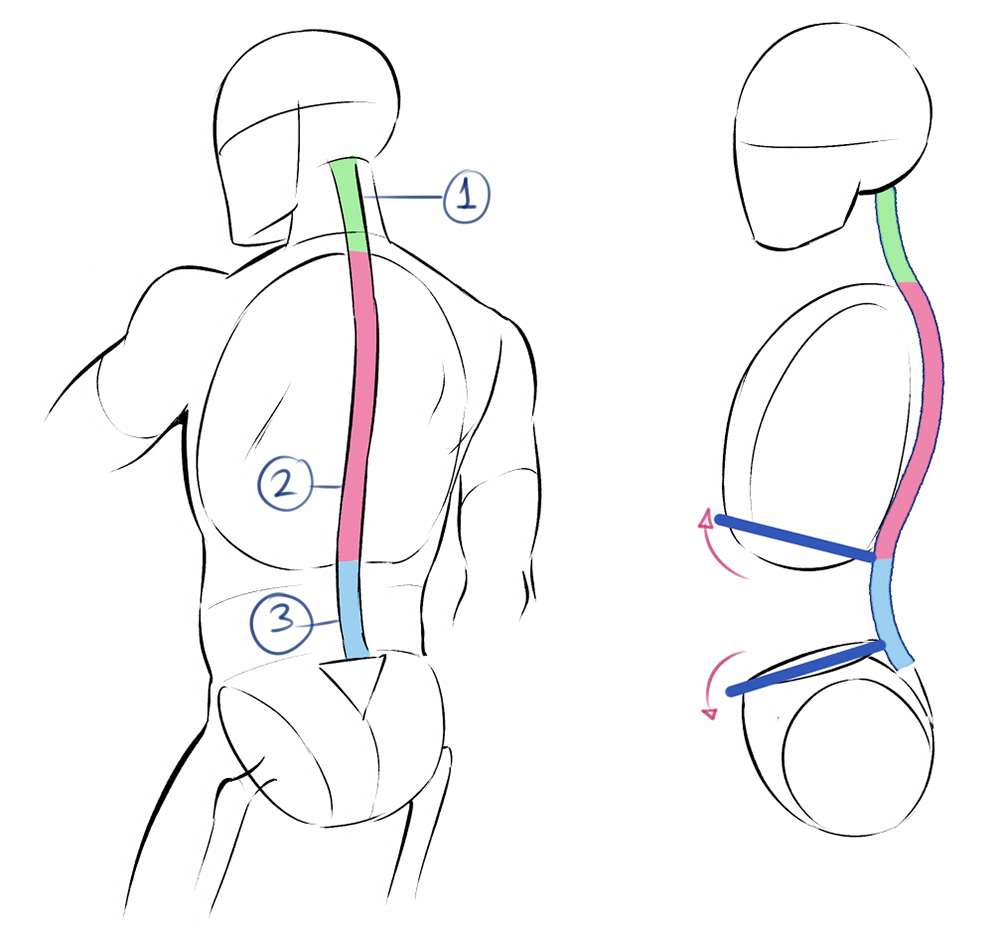
The spine is the trunk's support, also allowing motility in the trunk. Its vertical shape differentiates humans from other species. It is not a directly line, but a bend. Its shape makes the pelvis and the rib cage tilt slightly. Let's divide it up into 3 parts to run into information technology meliorate:
- Cervical spine — supports and provides mobility to the head
- Dorsal or thoracic spine — supports the ribs.
- Lumbar spine — a little earlier the pelvis, continued to the sacrum.
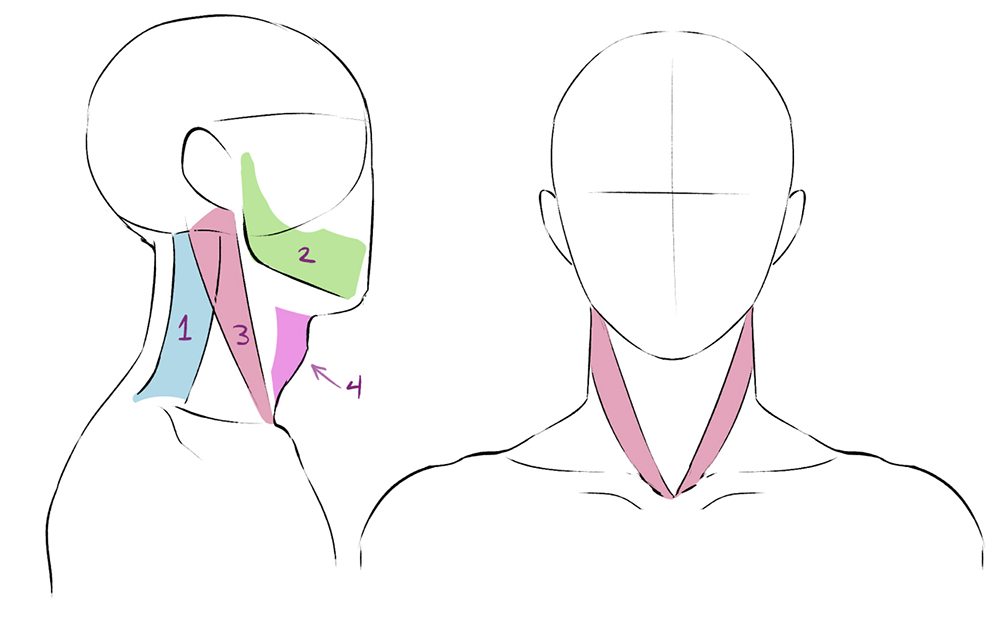
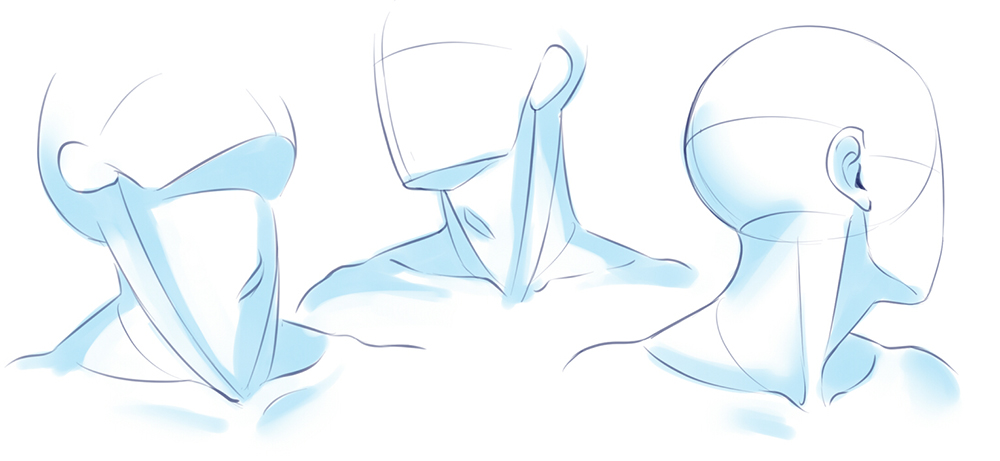
In the neck, the cervical spine (i) is located only behind the jaw (two). In that location are a variety of muscles that operate the motility of the head. The most visible 1 has a very, very long name (sternocleidomastoid!), but you can easily recognize it by its V shape, parting from the ear to the centre of the clavicles (3). In the centre of these muscles is the Adam'southward apple, which is more than prominent in men (4).
The dorsal spine is the part that connects to the arms. Y'all can describe information technology in many ways, I similar to give it an ovoid shape that resembles the shape of the ribs (one).
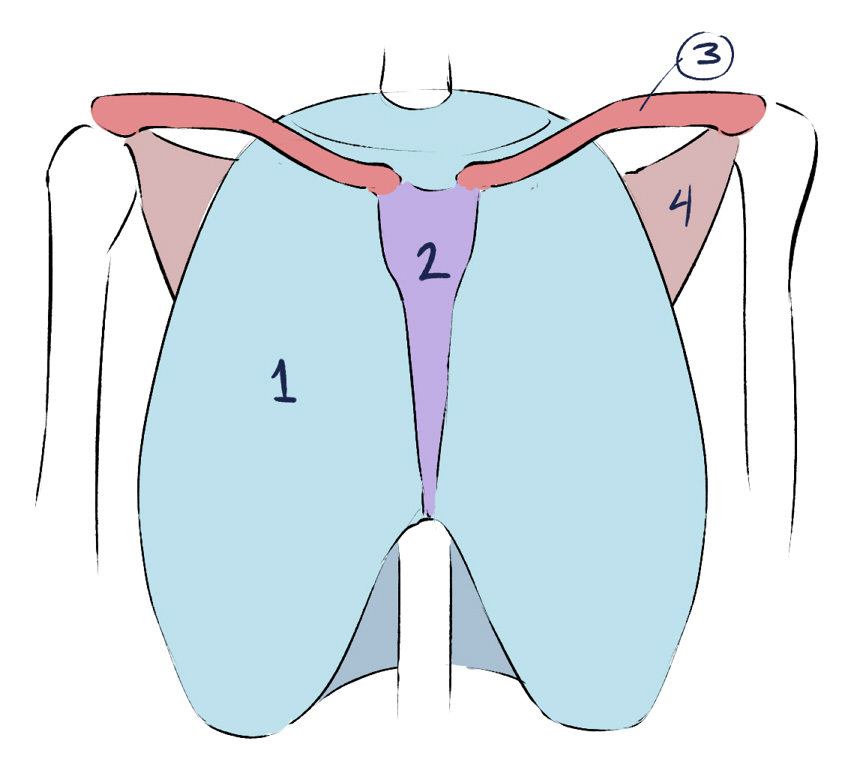
The sternum (2) closes this structure in the front, creating, with the spine, an imaginary line that divides the body into two. Use them as a guide!
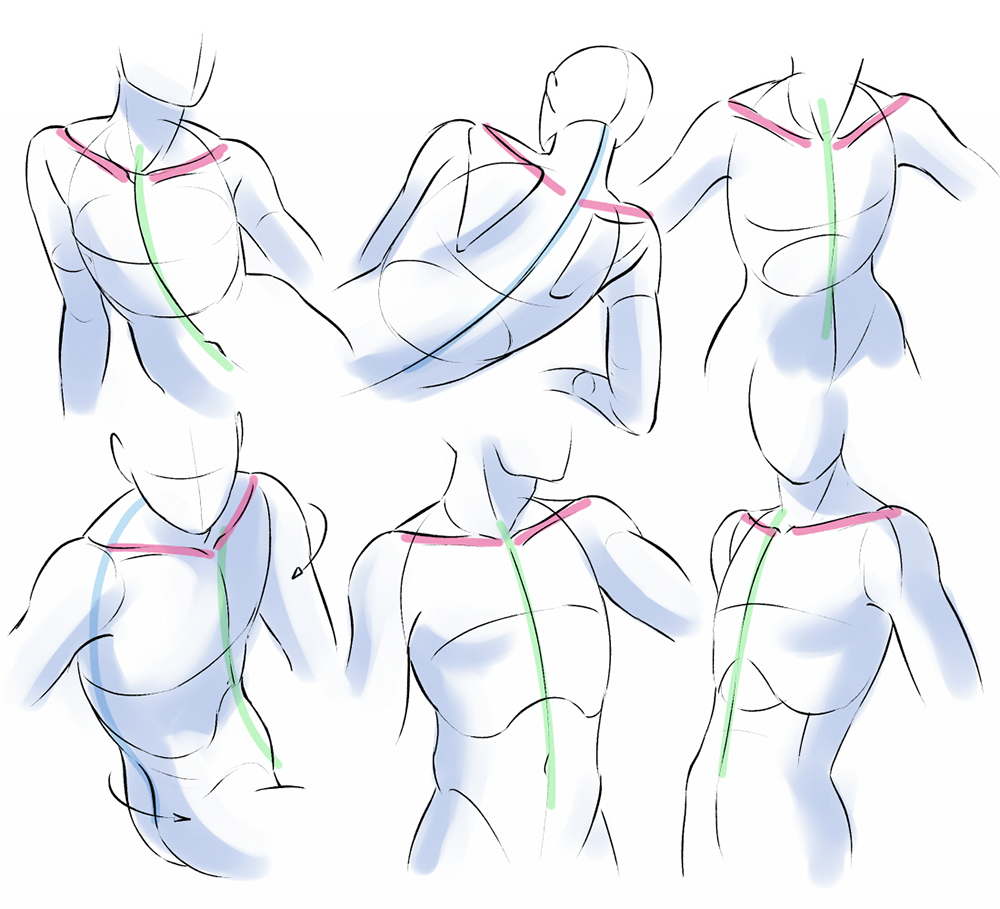
The clavicles (3) are like a bicycle handlebar, you can remember of them every bit a shoulder support. Every time the arms motion, they volition change direction.
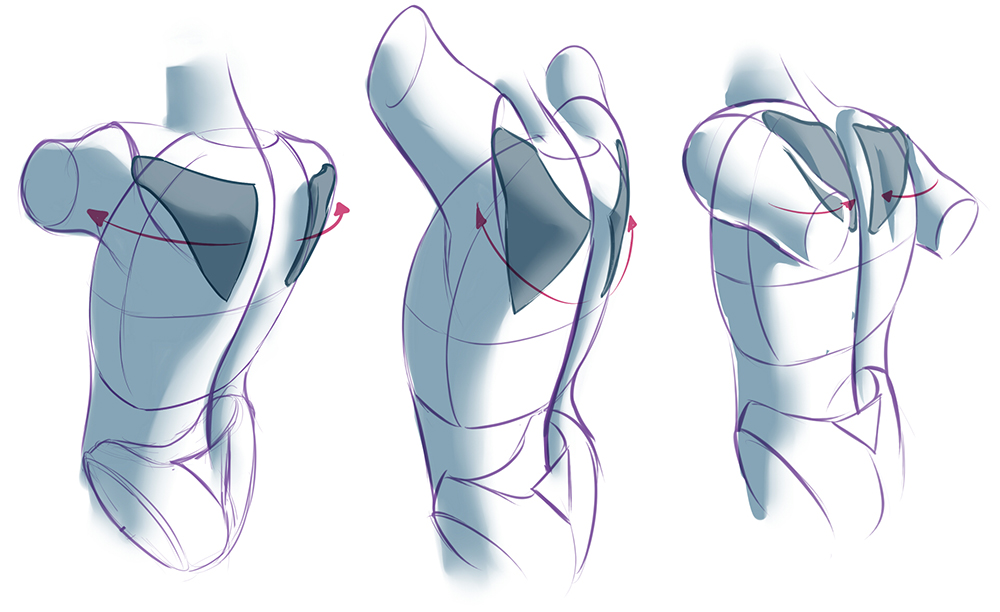
In the dorsum, you lot will detect the scapulae or shoulder blades. They are triangle shaped and help move the arms. The shape of the back changes following the movements of these bones.
The pelvis is located at the finish of the torso, connected to the lumbar spine from the sacrum (1). On both sides yous can come across the ilium (2); and in the front, the pubis (3).
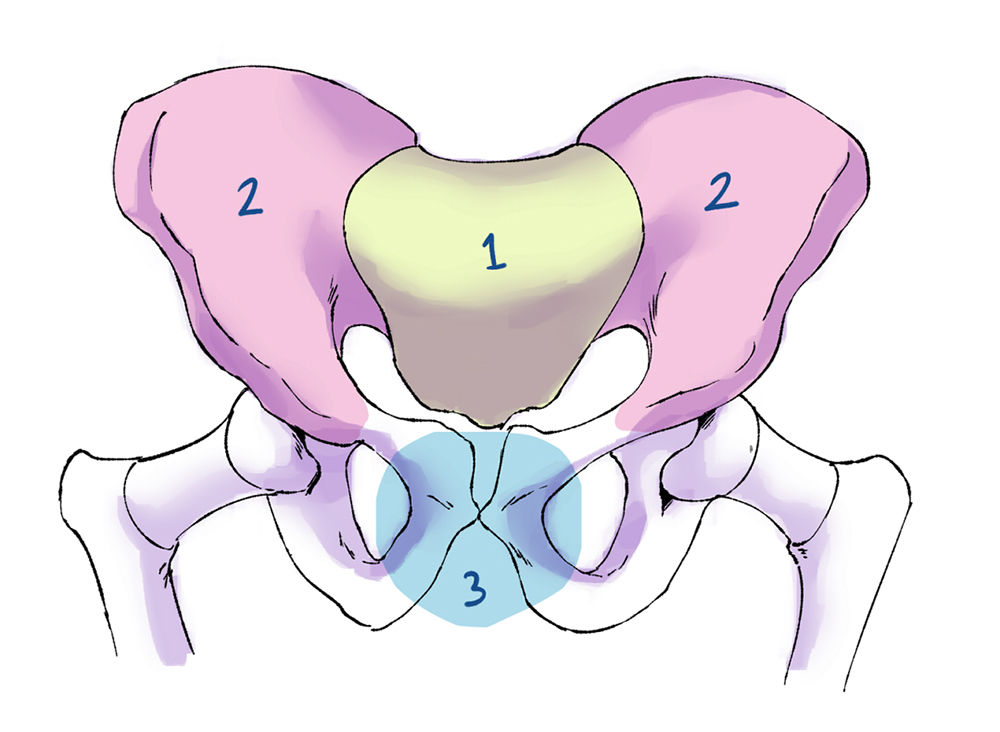
Equally these are somewhat irregular bones, I like to simplify them by drawing a pair of discs for the ilium, and the sacrum equally an inverted triangle.
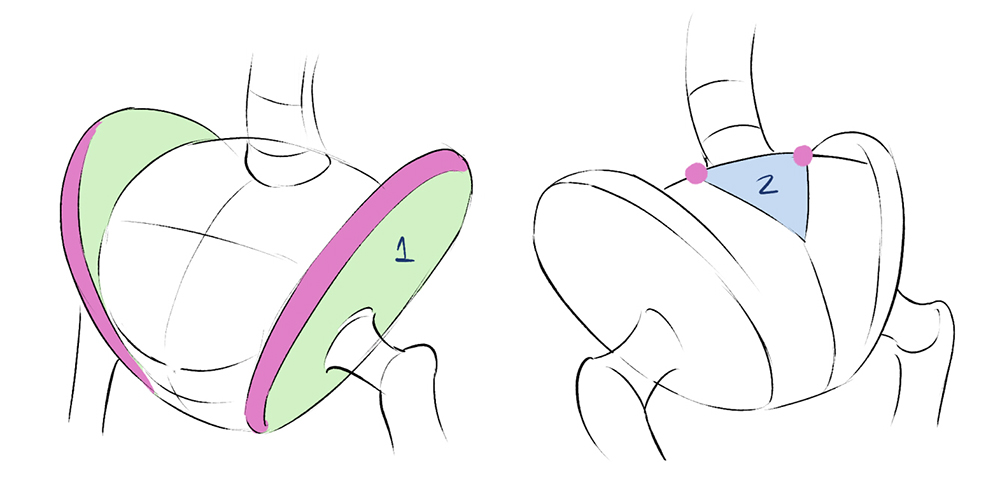
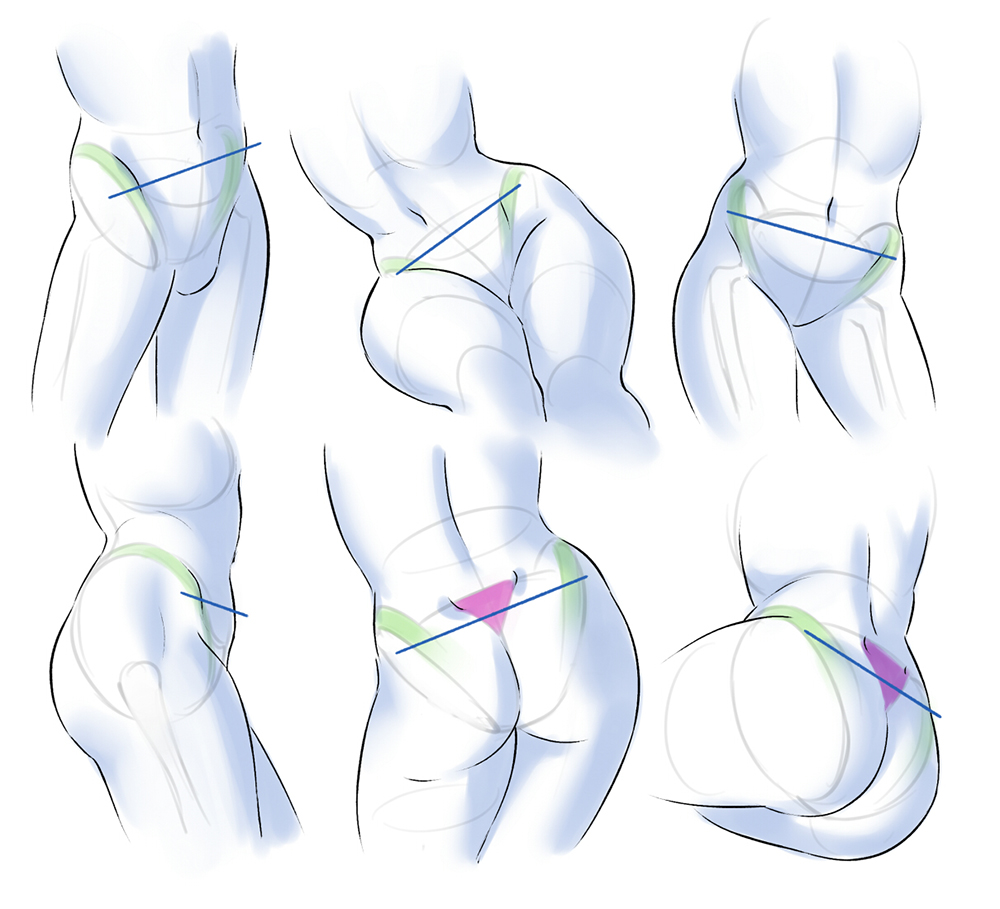
The ilium (1) will guide yous to draw the angles of the hip. On the back, these two dimples at the end of the spine, before reaching the buttocks, will assist united states of america identify the sacrum (2).
Annotation that female person hips are generally wider than male hips — one of the main differences.
Limbs
Limbs can move in many ways, but knowing their limitations will relieve the states from drawing unrealistic poses (or bone-breaking poses, ouch!).
Arms:
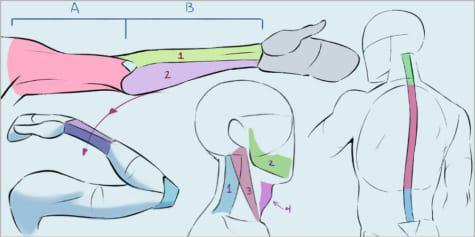
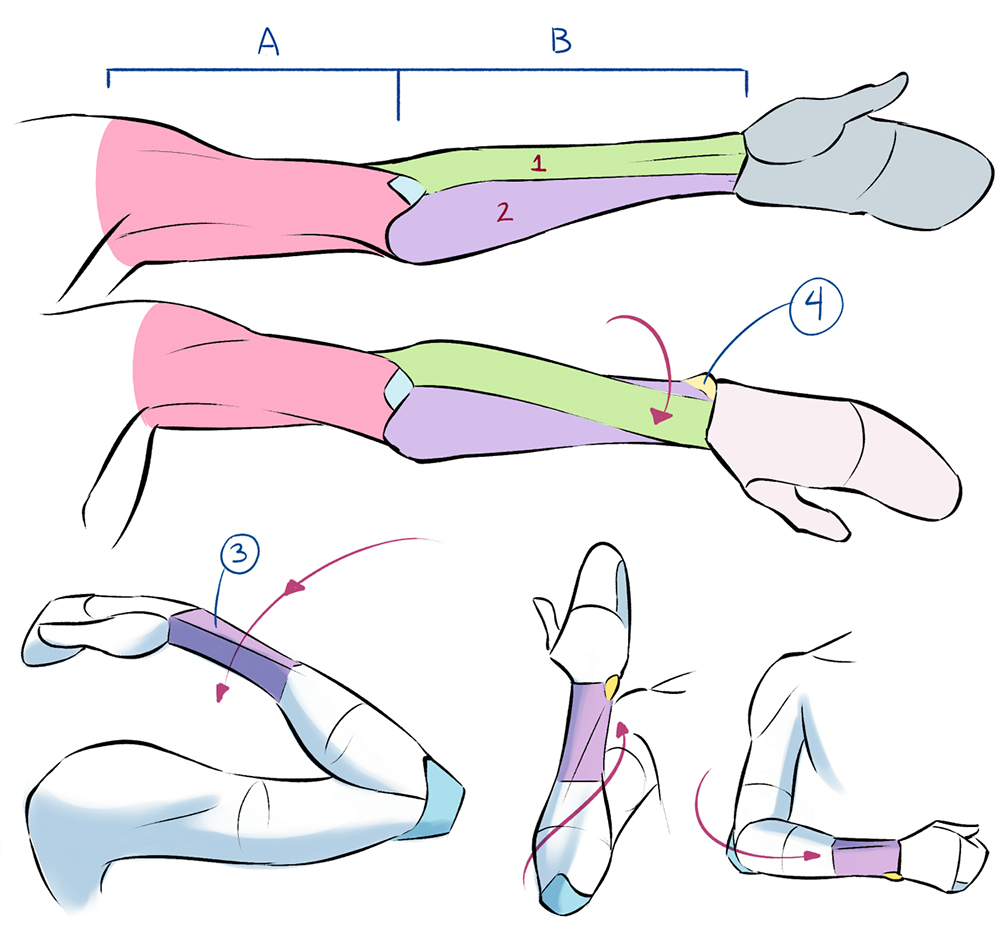
In the upper office of the arm (A) in that location is the humerus, a long and strong bone that connects to the elbow and articulates the forearm (B).
In the forearm you will discover the radius (1) and the ulna (2). These bones cross to permit the rotation of the wrist. Some artists draw part of the forearm every bit a box to ascertain its volume (three).
Tin can you lot come across a tiny lump but behind your wrist? (4) It is part of the ulna. You can use information technology as a reference point to locate the orientation of the arm.
Legs:
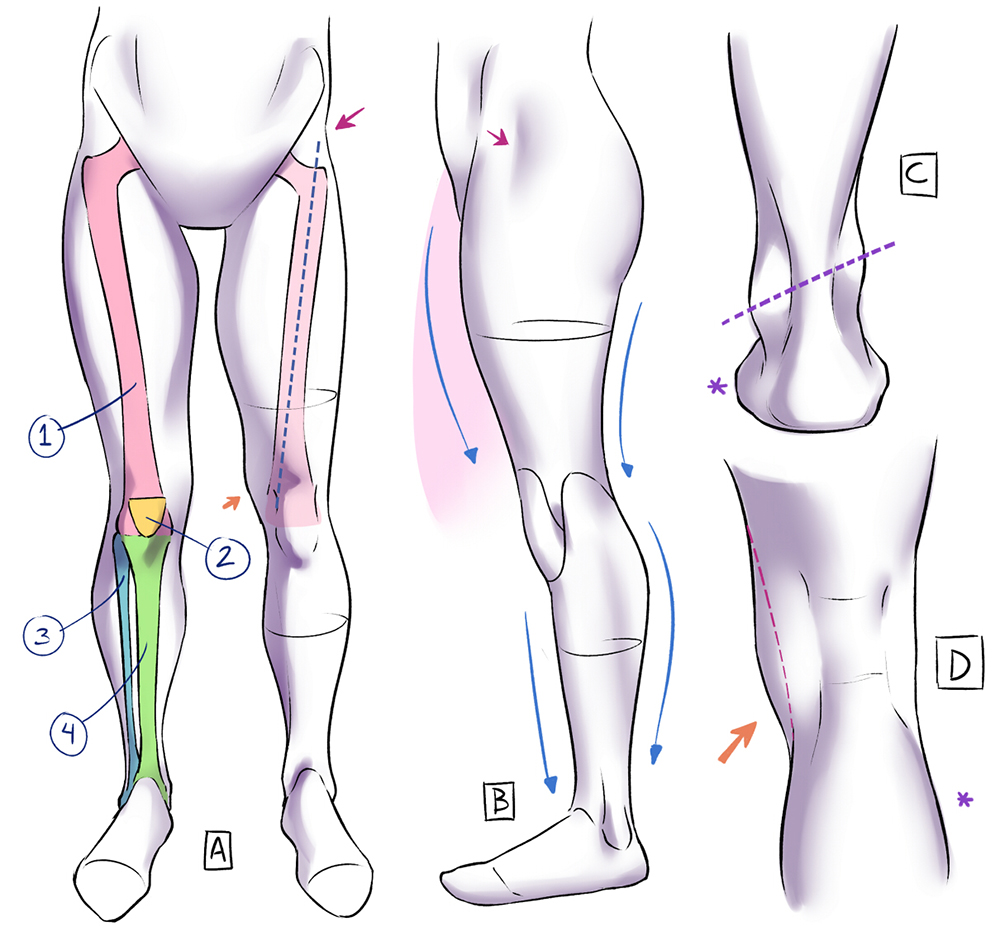
In Fig. A we accept the leg bones:
The femur (1) in the thigh; the knee (2) in the middle of the leg; the fibula (3) and the tibia (four) in the calf surface area.
The legs should back up the trunk and give information technology the residual it needs, but in that location is a particular that sometimes escapes the states: the legs practise not have completely vertical line. In guild to achieve balance, there must be rhythm. Discover the slight inclination in the femur from the hip to the human knee, and the curves (fig. B) that create the profile of the leg (side view).
Other interesting details about the leg:
Between the hip bone and the femur, in that location is a space that can be seen every bit an indentation in the skin, mainly in men who have less musculus mass in that area.
In figure C, nosotros have the talocrural joint. Its basic are placed at different heights, with the fibula on the outer side (*) beingness lower.
Figure D is a back view of the knee. On the outer side (*) the muscles do not generate likewise much change in the contour, but on the inner side a small lump is created (I accept also pointed this out in figure A).
Proportions
According to some academic standards, seven or 8 heads is the ideal summit of an adult. However, each person has different proportions according to their physical characteristics. If you compare people of different heights yous volition notice that individually they maintain proportions according to their own body.
To prove this, let us look at the following case: two adults, a human and a woman. Although the female figure is shorter, her body is divided into seven heads (which fits within the standard) and the male figure is only a tertiary of a head taller
In the example I have also included the figure of a child. Take into account that, at early ages, the body has not developed completely, then their measures are a piddling undefined. This ane is nearly 5 heads high.
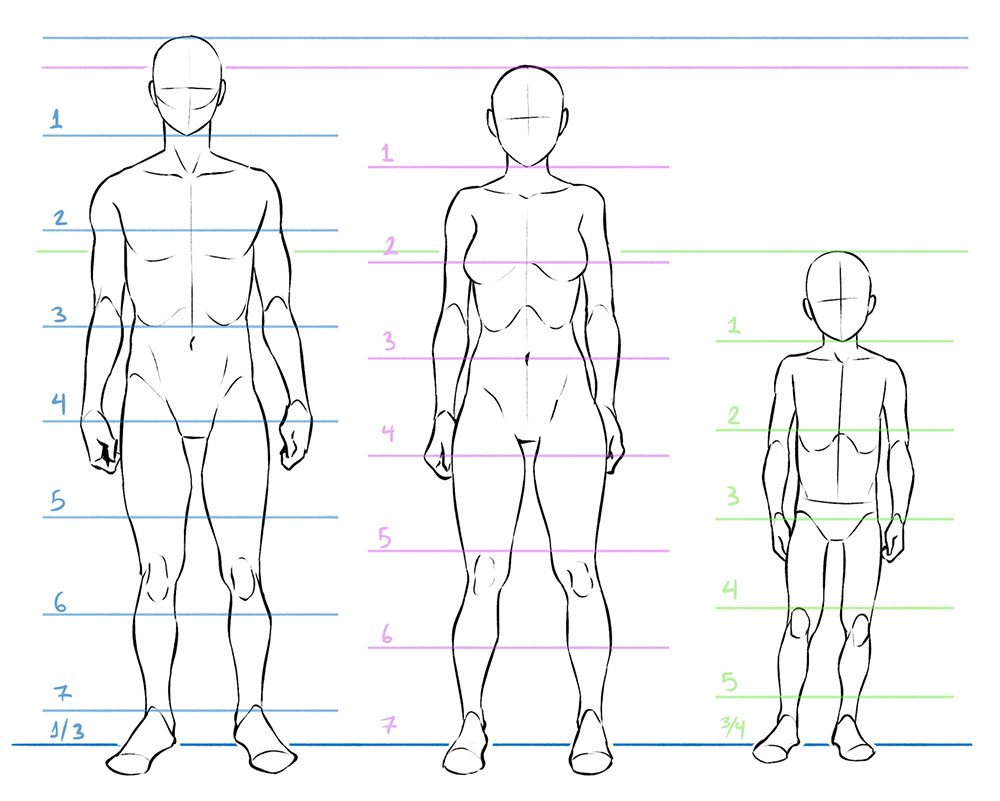
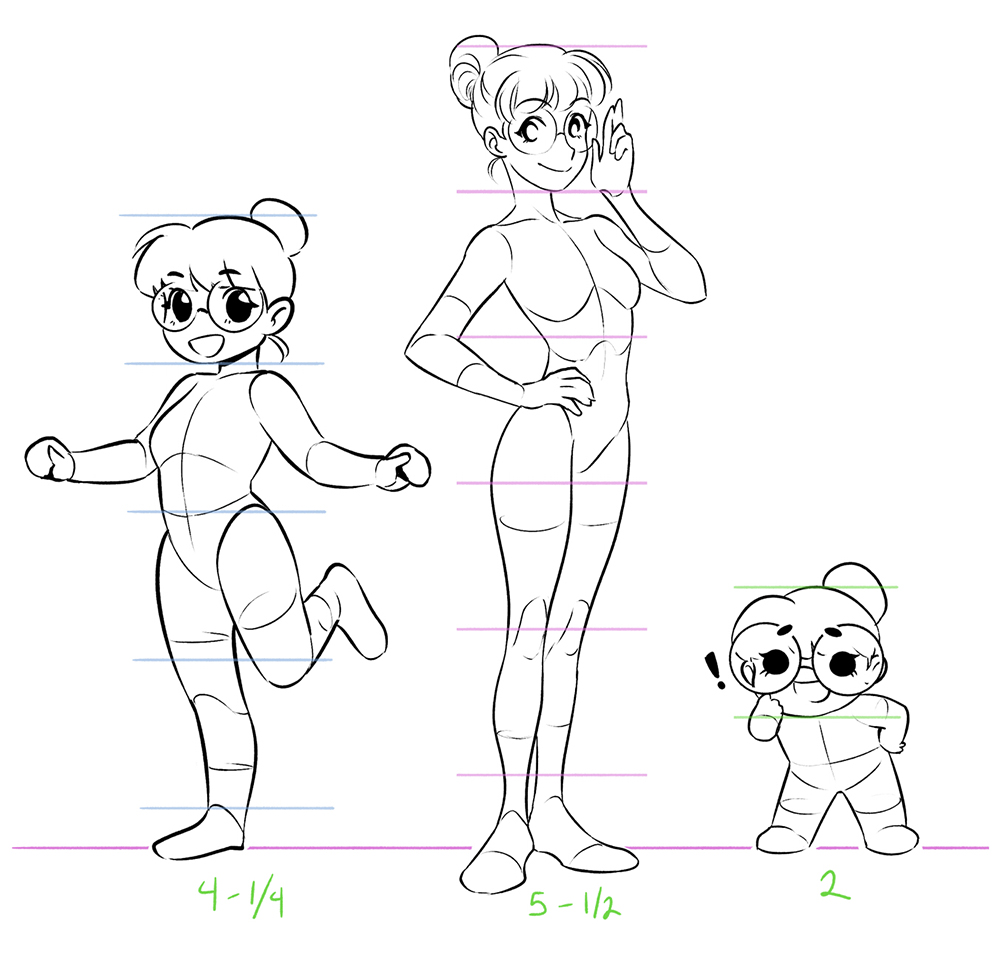
Aside from this, artists do change their characters' proportions totally out of these "ideal" ones, to emphasize their unique characteristics or to enhance their drawing styles. (Just this is not an excuse to ignore the fundamentals!)
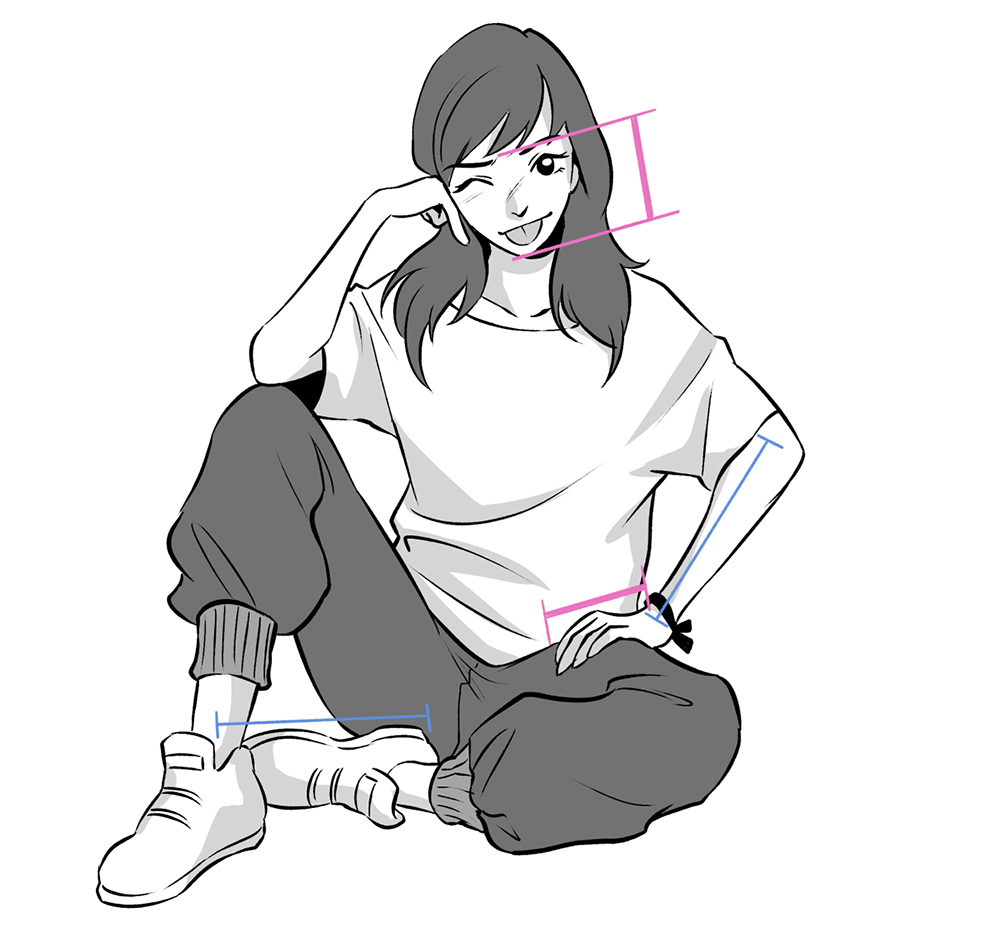
A trick! I like comparison elements of the aforementioned length, just to brand sure that everything is well proportioned as I depict. For case, the hands are almost the size of the confront; the anxiety are every bit long as the forearm.
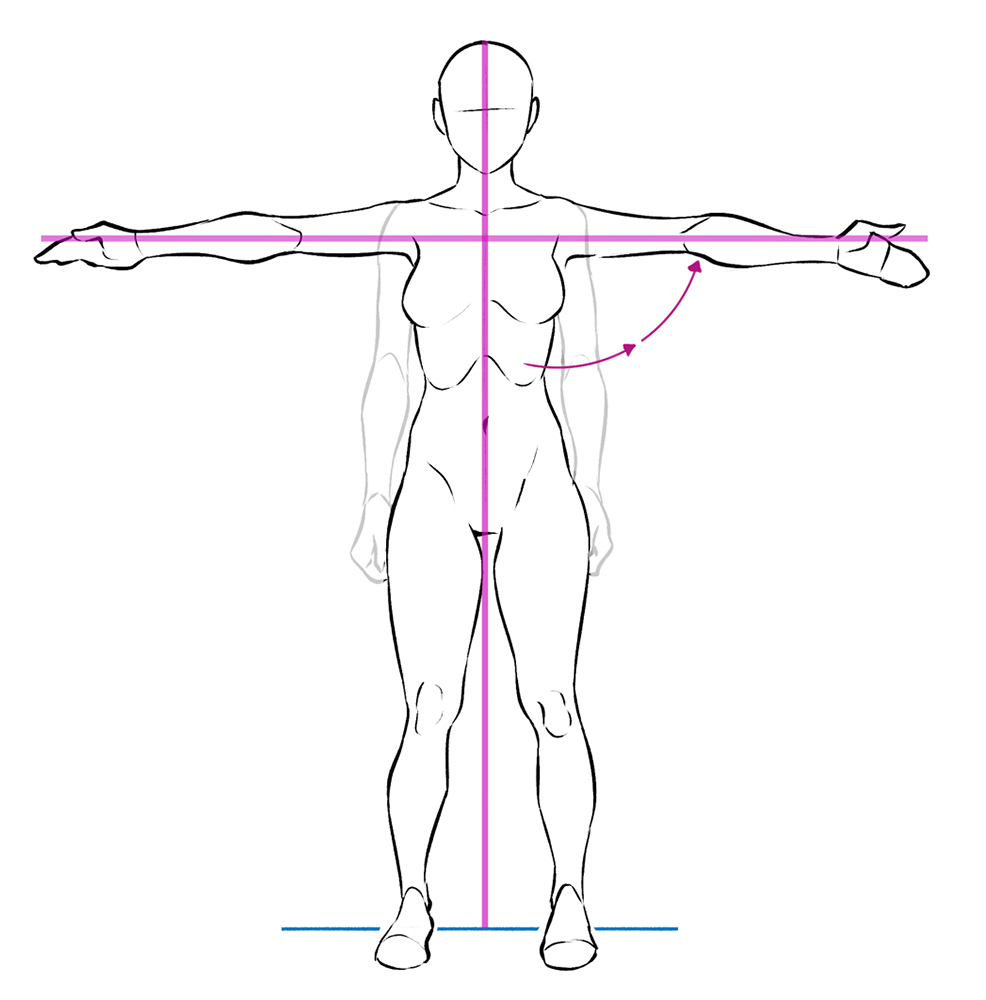
Another piece of information that I find fascinating is the fact that, if you extend your arms, they are side to side the same length as your height!
Finally, four points which will help u.s.a. to become better at drawing day past day.
- Observation: Study how people walk, their poses, the different types of bodies… Create a reference gallery in your listen and, if possible, accept pictures!
- Retrieve in 3D: To sympathise a figure/shape, the all-time thing is to clarify information technology from different perspectives.
- Research: Read almost body parts, basic, muscles, functions, etc. From an artist'south point of view is fine, you do not need to become a doctor! We are interested in those anatomy parts which bear on the shapes and movements of the body.
- Draw, describe, draw! Practice cartoon the whole figure and detailed studies of some specially difficult parts.
Thank you very much for reading!
If you lot similar, y'all can check out my social networks and my portfolio to see some of my work.
Bring Free energy and Life to Your Poses!
Source: https://www.clipstudio.net/how-to-draw/archives/161109
0 Response to "Should I Learn Body Parts Before I Start Drawing Anatomy"
Post a Comment