What Three Things Can We Move in the Theme of Movement?
Suggested Citation:"7 How Is the Movement of People, Goods, and Ideas Transforming the Globe?." National Research Quango. 2010. Agreement the Irresolute Planet: Strategic Directions for the Geographical Sciences. Washington, DC: The National Academies Printing. doi: 10.17226/12860.
×
seven
How Is the Move of People, Goods, and Ideas Transforming the World?
Without the motion of goods, people, and ideas, cities stammer, economies wane, and societies wither. Every bit local economies and their associated land uses accept get more specialized, mobility has grown e'er more central to the sustainability of deed. Economic specialization, which has fueled productivity growth and propelled the dispersion of interlinked activities worldwide, is premised upon diverse forms of mobility, including the migration of labor from depression-wage to loftier-wage places, the daily travel of workers from their homes to workplaces, the movement of materials to worksites, and the distribution of finished products to markets. When mobility ceases, as in the instance of a natural disaster, not only do workplaces fall idle, but also people cannot get emergency medical attention, families cannot obtain food, and social gatherings of all sorts are canceled or postponed.
The increasing importance of mobility to local, regional, and global economies and to everyday life is reflected in data showing the relentless increment in many measures of the movement of people and goods (Figures seven.1 and seven.2). In the United States, the motion of people and freight has been steadily increasing.1 At the international scale, human migration more than than doubled between 1970 and 2000, with the largest proportion of migrants moving to countries in the developed world (Figure 7.two; Clark 2006a), and climate change is likely to accelerate these trends (see special issue of Forced Migration Review, 2008).
The show of steadily increasing mobility runs counter to the claim that distance—and the movement required to overcome it—no longer matters because of high-speed data and communication technologies (ICTs; due east.thou., Cairncross, 1997). If ICT has rendered altitude irrelevant, as suggested past the expiry-of-distance hypothesis, and then people and businesses should have little reason to incur the time and money costs involved in moving themselves or goods over increasingly greater distances. People would rely primarily on the keyboard and mobile phone to achieve destinations of interest, and measures of mobility would autumn. Although ICT has had impacts on physical movements at the calibration of daily travel and may have afflicted migration streams (eastward.g., via the outsourcing of software development and telephone call centers to Republic of india), the nature of the impacts is complex and generally has non conformed to predictions associated with the decease-of-distance hypothesis (Mokhtarian, 2003; Janelle, 2004).
Persistent upward trends in mobility reflect rising affluence in some cases (equally in the United states of america) merely tin also exacerbate differences among places (as when people motion from rural areas to cities); in addition, rising mobility is associated with escalating conflict in some instances (as in refugee flows) and tin can produce high levels of urban congestion. Considering of the stiff links between motorized movement and petroleum consumption, ever-increasing mobility also raises concerns about greenhouse gas emissions. Transportation
| i | One exception is residential mobility, which has declined in recent decades. The proportion of the U.Southward. population that changed residence in any given yr has fallen from about 20 percent in the 1950s and 1960s to 12-13 percent in recent years (2006-2008). See www.census.gov/population/socdemo/migration/tab-a-1.xls (accessed Jan 20, 2010). |
Suggested Citation:"7 How Is the Motion of People, Goods, and Ideas Transforming the World?." National Enquiry Quango. 2010. Understanding the Irresolute Planet: Strategic Directions for the Geographical Sciences. Washington, DC: The National Academies Press. doi: 10.17226/12860.
×
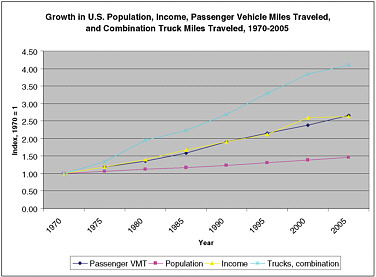
FIGURE 7.ane The rise in rider vehicle miles traveled (VMT) since 1970 in the United states closely tracks increasing incomes just well exceeds population gains. In the United states of america, passenger VMT in 2005 was more than than two.five times VMT in 1970 whereas population grew by a factor of just ane.v. Worldwide, passenger travel (kilometers traveled) more than quadrupled between 1960 and 1990 and is expected to more than than quadruple again by 2050 (Schafer and Victor, 2000). NOTE: "Trucks, combination" combines all vehicles with two or more units, one of which is a tractor or directly truck ability unit of measurement. Miles-traveled statistics are for highway travel. SOURCES: Passenger VMT data from National Transportation Statistics, Table 1-32; population statistics from U.S. Census Agency (2007), Table 2; combination truck statistics from Federal Highway Administration (annual series), Table VM-i.
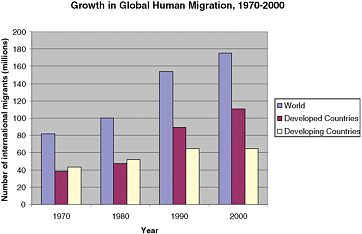
Figure 7.two The full number of international migrants in the world increased steadily between 1970 and 2000, with an increasing proportion of such migrants moving to adult countries equally migration destinations. SOURCE: Adapted from International Organization for Migration (2005).
Suggested Citation:"7 How Is the Move of People, Goods, and Ideas Transforming the World?." National Research Council. 2010. Agreement the Irresolute Planet: Strategic Directions for the Geographical Sciences. Washington, DC: The National Academies Printing. doi: x.17226/12860.
×
accounts for about one-third of the U.S. carbon emissions stemming from energy use. The reliance of the transportation sector on petroleum and its significant contribution to carbon emissions places mobility on geopolitical and climate change agendas.
ROLE OF THE GEOGRAPHICAL SCIENCES
Geographical patterns of human activity, such equally settlement patterns or the locational arrangements of manufacturing or services, are shaped by patterns of mobility. With expertise in analyzing connections betwixt spatial patterns and processes, the geographical sciences investigate the causes and consequences of mobility at varying spatial scales. Early work established that increases in accessibility provided through expansion of, and improvements to, the road network fundamentally contradistinct the settlement system; as travel speeds increased, larger places grew, whereas smaller places declined and sometimes disappeared altogether (Garrison et al., 1959). Underscoring the relationship between mobility and state-use patterns, enquiry has also demonstrated that improved access via expanded road capacity leads to increased traffic flows (Sheppard, 1995), which further reinforce differences betwixt and among places. Moreover, some of those impacts are felt in places that are quite distant from the network segments that were improved (Giuliano, 1995). A remaining enquiry claiming is to understand how to increase accessibility without exacerbating the traffic congestion that now plagues cities around the world.
Research has begun to identify the specific aspects of places that are salient to mobility processes and will therefore make up one's mind how increasing mobility will modify the world differently in unlike places. Research to engagement suggests that the causes and consequences of increasing mobility volition go along to have certain common threads across places, while too differing in of import ways from place to place. However, much remains to be learned virtually the reasons for and outcomes of those differences.
The spatial separation of specialized land uses—such as food stores or urban center parks at the local scale or the manufacture of magnetic recording heads for 30 pct of the earth's computer difficult drives in Dongguan, China (The Economist, 2008) at the global scale—makes economic specialization and calibration economies visible on the landscape. Relatively cheap and undecayed mobility from the local to the global scales has enabled this grade of spatial organization to become truly global, with loftier levels of specialization twinned with long-distance linkages integrating the global infinite-economy (Dicken, 2003). Because connectivity varies from place to identify (Figure 7.3), these mobility-based globalization processes have contributed to the patterns of inequality discussed in Affiliate 8.
Place-specific policies can play a function in shaping the nature of the relationship between geographical blueprint and process. At the intraurban scale, Giuliano (1995) showed that the country-use impacts of transportation investments are highly variable from identify to identify because they depend on local economic and political conditions. For example, the lite-track transit (LRT) built in Buffalo, New York, in the 1970s, failed to revitalize that urban center, whereas Portland, Oregon'south LRT has been key to a suite of policies that have supported the continued vibrancy of Portland'south city middle and helped increase the share of travel made via public transit. Similarly, Mountz (2004) documented how international migration flows, specifically those involving human smuggling, are influenced by the micro decisions of clearing bureaucrats in destination places. Her ethnographic study of the differential receptiveness of places within Canada to immigrants illustrates the importance of governance practices and structures at national and provincial levels.
Geographical technologies, especially geographic information systems, facilitate the tasks of analyzing place-specific dimensions of mobility patterns and processes at varying spatial scales. At the regional level, the adoption of such technologies past planning agencies has transformed the ability of planners to create optimal designs and communicate projected impacts of unlike planning scenarios to the public (Nyerges, 2004). At the individual level, the rapid adoption of Global Positioning System (GPS) technologies is altering the mobility of vehicle drivers, pedestrians, and cyclists. Still largely missing are comparable systems for wayfinding indoors, as in large retail complexes, and for helping the visually dumb, such equally "talking signs." The potential impacts of the widespread adoption of these technologies are substantial. For example, if everyone is capable of finding a destination, then the destination need non annunciate its location or adopt
Suggested Citation:"7 How Is the Movement of People, Goods, and Ideas Transforming the Globe?." National Enquiry Council. 2010. Understanding the Changing Planet: Strategic Directions for the Geographical Sciences. Washington, DC: The National Academies Press. doi: 10.17226/12860.
×
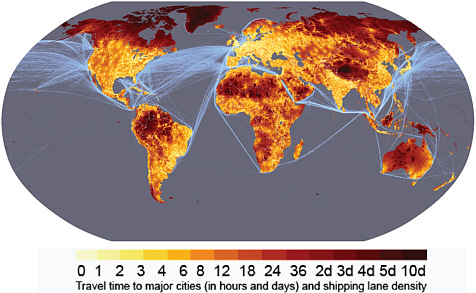
Effigy 7.3 Global accessibility map showing that the time needed to travel to a city of 50,000 or more population varies substantially. The map shows that only x percent of the world's land area is more than than two days' travel by land or h2o from a urban center of that size. Imagine the accessibility differences that would get apparent past creating other maps like this at different scales and with other admission criteria, such as distance to a city with a population of at to the lowest degree 100,000. SOURCE: © European Committee, 2008.
a location that is prominent in the landscape, such as a street corner. The following enquiry questions provide examples of the types of movement and mobility issues the geographical sciences are specially well positioned to investigate.
RESEARCH SUBQUESTIONS
How does virtual interaction reflect and alter the organisation and movement of people, appurtenances, and ideas in geographical space?
Only as physical mobility has been increasing in many unlike ways, then has virtual interaction via the Internet, telephone, videoconferencing, email, cell phones, and text messaging. Despite initial predictions that virtual interactions via ICT would eliminate or substantially reduce the need for movement, inquiry indicates that these forms of interaction are complementary and synergistic, rather than substitutable; in some cases ICT increases rather than decreases mobility (Mokhtarian and Meenakshisundaram, 1999; Mokhtarian, 2003). In the business concern world, face-to-face contact remains the virtually essential form of interfirm interaction (due east.g., Melt et al., 2007), with electronic mail, phone, and videoconferencing used to supplement rather than supplant face up-to-face interactions. Because of the importance of contiguous communication for these firms, business success depends on geographical, not virtual, proximity to other firms, giving rise to a daily movement of workers to dense clusters of firms that fosters growing traffic congestion.
Enquiry has begun to accost the dynamic relationship between virtual interaction and the motion of people and goods. Understanding this relationship will exist necessary for designing policies aimed at reducing energy consumption, managing urban congestion, and cut greenhouse gases. Schwanen and Kwan (2008) showed that the ways in which ICT affects individuals' movements depend on context (type of activity undertaken, place, time, technologies available). The main affect appears to be that mobile ICT
Suggested Citation:"seven How Is the Motion of People, Goods, and Ideas Transforming the World?." National Research Council. 2010. Understanding the Changing Planet: Strategic Directions for the Geographical Sciences. Washington, DC: The National Academies Press. doi: 10.17226/12860.
×
allows for more temporal flexibility in the scheduling of activities, whereas the Internet allows for greater spatial flexibility of activities, peculiarly work and shopping. As new forms of ICT, especially mobile ICT, are more widely adopted, research can illuminate which kinds of concrete movements are most afflicted and how; for instance, such engineering science can enable new forms of ride sharing that could reduce carbon emissions.
The geographical sciences are besides well positioned to assist industries with finding optimal ways to combine increasingly important virtual interaction with the persisting importance of grounded contacts. For example, Aoyama and Ratick (2007), using data from a nationwide survey of logistics firms and from interviews they conducted with logistics providers and users in the northeastern Usa, found that although the utilise of ICT tools is widespread, traditional trust-based relationships remain fundamental to logistics operations.
Research points to the value of examining the complex dependencies between virtual and physical forms of interaction. Further enquiry is needed on how specific aspects of places (e.g., settlement density, cultural norms, network configurations) affect the relationship between virtual and concrete mobility. A combination of geographical approaches, including time-space studies of human move in different environments, tin can illuminate how, for example, increasing road congestion or energy costs are likely to change the ICT-mobility relationship or how new forms of ICT, including the deployment of GPS systems in jail cell phones, might alter the ICT-movement relationship. Understanding how the speedily evolving forms of virtual interaction reflect and modify the organization and move of people, goods, and ideas in geographical space volition require detailed, geospatially referenced information at the levels of the person, household, and firm. One promising avenue is the utilise of information from cell phones equipped with GPS units; such information accept proved constructive in measuring the spatial dimensions and intensity of social interactions (Eagle et al., 2009).
How do changing energy costs influence the motion of people and commodities and the geographical organization of the mural?
The global economic system is dependent on inexpensive, arable energy. Articles published in 2008 in the New York Times and Washington Post argued that sharply increased fuel costs had curtailed global supply chains and challenged the only-in-fourth dimension delivery procedure that manufacturers worldwide have come up to rely on (Cha, 2008; Rohter, 2008). The paper stories tell of several manufacturers that had recently shifted their operations from Mainland china to the United States because of large increases in aircraft costs (from approximately $iii,000 in 2000 to approximately $viii,000 in 2008 for a 40-ft container), which had come to trump China's lower labor costs. Following classical economic geography theory (Weber, 1929), the industries that are most likely to relocate and restructure when aircraft costs skyrocket are those, such equally steel and furniture, that produce goods that are high in bulk or weight relative to their selling toll.
Relatively little is known about how the mobility behavior of U.S. firms and consumers might respond to sustained, significant price increases in energy. The historical tape is not helpful because the United states of america has not experienced the kind of prolonged, substantial price increment in petroleum that might atomic number 82 to contradistinct mobility and land-utilise patterns. The rapid and dramatic, just relatively short-lived, price increases following the oil embargo of 1973 led to a small-scale, temporary dip in the mobility-growth curve shown in Figure 7.1, and the main midterm impact was the consumer shift to smaller, more fuel-efficient vehicles. Comparisons with Europe, where higher taxes on fuel have fabricated energy more costly than in the United States, are of limited use considering the distances to be traversed are far greater in the U.s. (in function because energy has been so relatively inexpensive) and considering mobility patterns are to a big degree culturally specific; the norms in Europe, regarding, for example, bicycling or the use of public transit, differ substantially from those in the United States.
Geographical research can provide important insights into how changing energy prices are likely to affect the movement of people and goods, the interaction of virtual and physical forms of mobility, and the geographical organization of the mural. Such analyses are non likely to be straightforward, however, because the parameters of the relationships involved are dynamic and place specific, and considerable uncertainty surrounds people's response to increasing energy prices. Economical theory suggests, for example, that every bit
Suggested Citation:"7 How Is the Motion of People, Goods, and Ideas Transforming the World?." National Enquiry Council. 2010. Understanding the Changing Planet: Strategic Directions for the Geographical Sciences. Washington, DC: The National Academies Printing. doi: 10.17226/12860.
×
the cost of ship rises relative to income, mobility will be curtailed, merely recent evidence does non support this contention. Hughes et al. (2008) compared consumers' sensitivity to increases in gasoline prices in 1975-1980 with those in 2000-2006 and constitute that the short-run cost elasticities for gasoline were significantly lower in 2000-2006, indicating that to consequence a reduction in gasoline consumption, much higher price increases volition be needed. Whereas these authors model the overall demand for gasoline in the U.s.a. as a function of toll, geographical scientists can, by disaggregating demand spatially, decide how such price elasticities are related to the geographical characteristics of unlike places. Spatial assay that is sensitive to place differences can as well demonstrate the range of probable impacts of energy price increases on people's residential choices and daily travel patterns.
How is migration reshaping local communities, labor markets, and ethnic and national identities?
Migration is a form of mobility that entails a change in residential location and can involve moves from the intraurban to the global scale. Although rising incomes and the ease of communication and render migration accept fabricated such moves less hard for some people, the fears and realities of epidemics and terrorism have rendered migration far more difficult for others, including Muslims, refugees, and people from areas with high rates of HIV/AIDS or Avian flu. Fences in Israel and at the U.South.-Mexico edge stand as proof that some borders are hardening, while the relatively contempo freedom of motion for workers within the European union is evidence of other borders softening (Figure vii.four).
Migration changes people, and it changes places. A alter in location ofttimes brings with it a modify in personal identity, with potentially major implications for politics in the receiving place. When migrants who have moved either brusk or long distances differ from residents in the receiving community, their arrival, specially in large numbers, brings change to that community, whether it is a neighborhood or a nation. In a world of relatively cheap travel, instantaneous advice, and deep divisions amid people, gimmicky migration poses new challenges to agreement these impacts. Among these challenges are the increasing circularity of migration, in which people render with some regularity to their identify of origin, the greater ease of sustained advice with people in the domicile identify, and the speed with which changes in i part of the globe are felt via refugee and migrant flows in other parts of the world.
Researchers take traced the impacts of migration on people and communities. In a study of Dalit circular migration within and beyond India, Gidwani and Sivaramakrishnan (2003) demonstrated that migration alters migrants' identities by broadening their feel and increasing their sense of agency. In the high-income countries of N America, Europe, and Asia, immigration is a topic of bully argue, especially as it affects receiving communities. Within the United States, for example, workers have voiced concern that the presence of immigrants depresses wages and takes jobs away from the U.S.-built-in labor force. Research has not nonetheless settled this debate, still. Using information from Los Angeles, Ellis and Wright (1999) demonstrated that because immigrants and nonimmigrants tend to work in unlike types of jobs, with newly arrived immigrants and U.S.-built-in migrants to Los Angeles channeling into non-overlapping sets of industries for piece of work, the presence of immigrants does not lower the wages of, or take jobs away from, U.Due south.-born workers. In contrast, others accept documented a diversity of immigrant impacts on native-born workers, including wage reduction (Borjas, 2006) and the move of native-born workers out of industries that become immigrant-intensive (Altonji and Carte du jour, 1991).
Whether migration is linked to altered or unchanged identities will vary from place to identify; comparative research tin can tease out the commonalities in these place-based relationships, which have strategic importance for migrant well-beingness every bit well as for political stability at various spatial scales (see Chapter ix). Research has shown how the ethnic makeup of migrant receiving communities can bear upon migrant identities and migration outcomes (due east.chiliad., Western, 2007). Migration can as well lead to hardened identities. In a written report of rural-to-urban migration in Ecuador, Lawson (2002) institute that, owing to the racism and economical hardship that migrants encountered in the city, they tended to retain their indigenous and regional identities from their rural places of origin. This finding is important because these migrants did not identify with other poor people in the urban center or join
Suggested Citation:"vii How Is the Move of People, Goods, and Ideas Transforming the World?." National Research Council. 2010. Understanding the Changing Planet: Strategic Directions for the Geographical Sciences. Washington, DC: The National Academies Press. doi: ten.17226/12860.
×
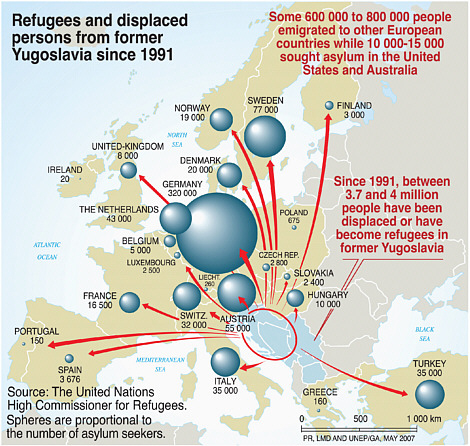
Effigy 7.4 Refugees and displaced people from the erstwhile Yugoslavia since 1991. There have been virtually 800,000 people who have left the sometime Yugoslavia since 1991. SOURCE: Un High Commissioner for Refugees.
with them to work for improved living and working conditions. The ethnic composition of a migrant's receiving community affects non only identity but also the degree of segregation amidst different groups and differences in income levels. Musterd et al. (2008), using longitudinal disaggregate data (1995-2002) from Statistics Sweden, discovered that whereas living in a neighborhood with high concentrations of co-ethnics is initially a boon to migrant incomes, such clustering can presently go a disadvantage. Moreover, the employment status of neighbors from other ethnic groups can have an impact, which is often positive if neighbors are employed simply negative if they are non. Additional studies along these lines can identify which characteristics of the local residential environment matter near to migrant outcomes and to the receiving community as a whole.
Where are the greatest points of vulnerability in the transportation network and what are the implications of disruptions at those points of vulnerability?
Mobility depends on integrated, well-maintained transportation networks. Although transportation networks have get denser in many parts of the world,
Suggested Commendation:"7 How Is the Motility of People, Goods, and Ideas Transforming the Earth?." National Research Council. 2010. Agreement the Changing Planet: Strategic Directions for the Geographical Sciences. Washington, DC: The National Academies Press. doi: x.17226/12860.
×
in the United States some network segments have been pruned back in recent decades. In the Great Plains, for example, many rural roads have been abased, in role because of declining rural population densities in some areas and in part considering of the increasing costs of maintaining older infrastructure such equally bridges. As networks are rationalized, the remaining ones get more vulnerable because there are no alternatives in the event of failure or attack. This problem is particularly apparent in the rail network, which has been drastically thinned equally the system has modernized and become more cost-conscious, to the bespeak that in some areas the network now lacks almost all redundancy.
Ports are especially vulnerable points in the nation'due south transport network. Assessing the impacts of losing major port facilities to disaster and identifying potential culling trade facilities should be 2 high-priority research topics. The ports of Los Angeles and Long Beach, for example, handle virtually one-quarter of U.S. total exports and 40 percent of all containerized cargo import traffic, a merchandise book equal to $256 billion in 2005 (BST Associates, 2007). The importance of these ports to the national economy is further underlined by the fact that more 60 per centum of the cargo arriving there is destined for markets outside Southern California (BST Associates, 2007), and two-thirds of exports originate exterior California (POLA/POLB, 2008).
The geographical sciences can as well contribute to identifying the greatest points of vulnerability in the U.South. transportation network and document the impacts that would follow should mobility through those vulnerable points exist lost. A recent National Inquiry Council report, Potential Impacts of Climate Alter on U.S. Transportation (NRC, 2008b), called attention to the vulnerability of transportation infrastructure to climate change, last that the well-nigh vulnerable places are probable to be in littoral regions. That committee's first recommendation was, in part, for governments to "inventory critical transportation infrastructure in low-cal of climate change projections to determine whether, when, and where projected climate changes … might be consequential" (p. 192). Transportation networks are vulnerable to far more than climate change, however, and the demand to assess network vulnerabilities and their consequences extends well across coastal areas.
The analytical tools of the geographical sciences are well suited to this task. Work by Peterson and Church building (2008) provides an case of both the potential and the current limitations of such enquiry. Using rail network data from Oak Ridge National Laboratories and freight information from the Bureau of Transportation Statistics,2 they developed a rail routing model to assess the loss of a rail bridge. Their analysis showed that, for all traffic going to and from Washington country that used the Sandpoint Span, the detours—upon the loss of the span—averaged 330 miles. Impedances increased every bit well, indicating that the selected detour routes were not ideal. Because the national track dataset lacks data on track capacity, this study was not able to take this of import variable into account. Because some routes are already operating at chapters, some freight might not be transported or trains could be forced to take even longer routes if the Sandpoint Span became impassable.
SUMMARY
Agreement how and why mobility and mobility consequences vary systematically from place to identify will be crucial for predicting the range of probable economical, environmental, social, and political impacts of increasing mobility and contradistinct mobility choices in the coming decades. Geographical scientists from several disciplines, including geography, civil engineering science, folklore, economics, and political science, are well positioned to accept up these questions.
Source: https://www.nap.edu/read/12860/chapter/12
0 Response to "What Three Things Can We Move in the Theme of Movement?"
Post a Comment